|
|

TODAY.AZ / World news
Experts comment on characteristics of Turkiye's devastating earthquake
09 February 2023 [15:57] - TODAY.AZ
By News Center
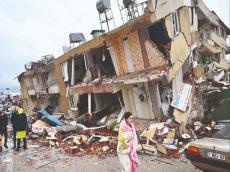
Experts have evaluated the Kahramanmaras-centered earthquake, which is one of the biggest disasters that Turkiye has ever experienced in the last century and destroyed 10 cities: The earthquake occurred with an energy accumulation of the size of 130 atomic bombs.
Experts in remarks on the big earthquake that affected 10 provinces in Turkiye yesterday warned that the break in the East Anatolian fault line may continue. Prof. Dr. Okan Tuysuz in remarks for Yeni Safak said that “the earthquake that hit the region was equal to 130 atomic bombs”.
Dr. Suleyman Pampal, on the other hand, said that the acceleration power of the earthquake reached twice the gravity. Here are the earthquake experts' assessments of the earthquake that jolted Turkiye.
Prof. Dr. Okan Tuysuz: “The Kahramanmaras earthquake is a huge earthquake, equivalent of 130 atomic bombs. It seems that it was felt in a very large area, at least 300 km in diameter. Considering its proximity to the surface, it is a shallow earthquake. It was felt in a wide area from Batumi to Egypt and Cyprus. The last time we witnessed an earthquake of this magnitude was on August 17, 1999. The biggest earthquake we have experienced in 23 years. This is an expected earthquake because the East Anatolian fault has been silent for many years. There was an earthquake in Elazig on January 24, 2020. After this earthquake, attention was drawn to the Pazarcik part of the East Anatolian fault. Considering that there has been no earthquake in the region since 1513, an earthquake of this magnitude is not surprising.”
Prof. Dr. Suleyman Pampal: “It was an earthquake that we expected and talked about for years. The East Anatolian fault, where the earthquake occurred, is one of Turkiye's most dangerous faults, one of the most active, and a fault that has been producing earthquakes for a while. In Sincik, Golba?i, Turkoglu, and Hatay segments of this fault line, there were seismic gaps, areas with high earthquake potential. These were the places where possible earthquakes were expected. Unfortunately, the current earthquake occurred when the Golbasi-Turkoglu gap was filled, that is, the segment was broken. The two sides of this segment, from Turkoglu towards Hatay and from Golbasi towards Sincik, are also waiting to be broken. It is possible for the gaps to produce earthquakes of this magnitude. It is also possible to say that the earthquake had a very strong acceleration by looking at the data we received from the sensors. According to this data, the earthquake reached an acceleration of two times the gravity. Considering that the average acceleration reaches 65 percent of gravity, we can understand the magnitude of the earthquake more clearly.”
Prof. Dr. Serif Baris: “Probably this is not a single earthquake. Especially when showing Hatay and looking at the epicenter of the earthquake, the fact that after the focal point in Pazarcik, Gaziantep, the fault comes so far into Hatay and deforms so much in the Amik Plain, this earthquake probably occurred from two earthquakes in a row. In fact, considering this fault, the expected magnitude of the earthquake in that region should be around 6.8-6.9. But according to current calculations, this earthquake has a moment magnitude of 7.7-7.8. This can only be possible if two faults break at the same time or break one after the other.”
After the earthquake that affected 10 provinces centered in Kahramanmaras, Earthquake Scientists, a remarkable statement came from Geophysics Engineer Prof. Dr. Ahmet Ercan. Ercan explained that the Demolition Force of the earthquake was 11 according to the Mercalli severity scale. Mercalli scale; quantifies the impact of an earthquake on the earth, people, natural objects, and structures on a scale of one to 12. By measure, one means imperceptible, and 12 means complete destruction.
Stating that the earthquake site was the junction of four main fractures, Ercan said: “The Dead Sea Fracture, Eastern Anatolian Fracture, Arabian Shield and Cyprus Arc. The largest possible earthquake in the Osmaniye Triangle was 7.4 on the Richter scale, 11 Destruction Power (Mercalli Cannani). The disaster is huge. The earthquake, which has been expected for centuries at the Hatay-Osmaniye-Kahramanmaras-Gaziantep fracture rift, has a magnitude of M7.4, with the power of approximately 130 atomic bombs that lasted 43 seconds on February 6, 2023, in the depth of 5 km, and is very effective. The disaster is huge on a cold winter day.”
Finally, “Turkoglu arm was broken on the Eastern Anatolian Broken Belt,” said Prof. Dr. Ahmet Ercan. “The focus of the next earthquake has shifted to the south, and Osmaniye, Adana, and Hatay have entered into the high hesitancy area. Moderate earthquakes can be expected here. It's too early for a big earthquake," he said.
Geology Engineer Prof. Dr. Osman Bektas also said that the earthquake in Kahramanmaras was the second-largest earthquake in the history of Turkiye. Stating that the earthquake triggered other faults, Prof. Dr. Bektas said that "as a result, this earthquake will cause destruction on the surface as well as cause energy distribution underground and trigger faults in the surrounding provinces. This trigger will advance the earthquake that may occur on some faults or delay the earthquake that may occur. This depends on the relationship of the incoming earthquake waves to the fault.”
Prof. Dr. Gurol Seyitoglu: “We are talking about an earthquake that occurred on the Eastern Anatolian Fault and that we have been waiting for a very long time. Considering the distance between the epicenter of the earthquake and Hatay, we see how great the acceleration towards the earth's crust is. The clearest indication of this is the 121-kilometer crack formed in the earth's crust. There will be aftershocks of this earthquake as well as earthquakes of equivalent magnitude, except for the Kahramanmaras earthquake, since the fault has not completely broken apart.”
Gazi University Faculty Member Assoc. Dr. Bulent Ozmen said that the Kahramanmaras-centered earthquake occurred on the Eastern Anatolian fault line, which has been a silent, unbroken line for about 480 years. Ozmen said, "This earthquake centered in Kahramanmaras has been recorded as the biggest earthquake that has occurred on the Eastern Anatolian fault since 1900."
Noting that there were many aftershocks of six or more after this earthquake, Ozmen said, “There will be aftershocks. The people of the region should definitely not enter their damaged buildings.
Earthquake Engineering Specialist Prof. Dr. Zeki Hasgur, “We experienced an earthquake that will go down in history. It is seen that the earthquake, which took place at a depth of seven kilometers, interacted with the Eastern Anatolian fault line as it is also in the Southern Taurus, Kahramanmaras, and Urfa thrust faults, Diyarbakir and Hatay. It caused a large number of aftershocks in the 13-kilometer area. This is the reason why it is felt in such a wide area.”
Prof. Dr. Zeki Hasgur continued his explanations about the risky regions as follows: “There have been small earthquakes in this region in the past, but there was no major earthquake in Iskenderun and Hatay. Therefore, the movement and interaction in this region will continue.”
AFAD Earthquake Risk Reduction General Manager Prof. Dr. Orhan Tatar, regarding the Kahramanmaras-centered earthquake, said, "The current picture seems to show that the part that did not break further south-west than the Elazig earthquake was broken." Stating that devastating aftershocks also occurred after the earthquake, Tatar said, “It is an earthquake that spreads over a very wide geography. We can say that a rupture occurred on the Eastern Anatolian fault zone along a line stretching from Malatya to ?skenderun and Hatay, and as a result, this earthquake occurred. Stating that the acceleration of the earthquake was measured as 664 gals, Tatar said, "We know that more destruction is expected in 100 or more gal."
The Kandilli Observatory and Earthquake Research Institute Director Prof. Dr. Haluk Ozener said, “We are talking about a 180-kilometer fracture.
It is the biggest earthquake in this region after the August 17 earthquake. At the meetings, attention is always drawn to the Marmara region. We have warned many times, do not just look at Marmara, we said that there are unbroken points on the East Anatolian and North East Anatolian fault lines. This was an unbroken segment on the East Anatolian Fault. Aftershocks can be expected to continue for a long time. We may experience more than six aftershocks,” he said.
After the earthquake in Kahramanmaras, "I wonder if it will trigger the expected Istanbul earthquake?" to the question of Prof. Dr. Zeki Gunduz said, “Of course, it is not possible for an earthquake on the Eastern Anatolian Fault Line to affect Istanbul. On a different fault line. However, as a result, our buildings in Istanbul, unfortunately, bear the same risk. Our building stock is quite old.”
By warning about the aftershocks that may occur on damaged buildings, Prof. Dr. Gunduz said, “A big earthquake will result and there will be aftershocks here. Damaged buildings should not be entered during these aftershocks. Aftershocks can continue for up to one year.”
URL: http://www.today.az/news/regions/231508.html
 Print version
Connect with us. Get latest news and updates.
See Also
- 05 August 2026 [14:01]
Israeli army destroys Hezbollah tunnel used for attacks - 05 August 2026 [11:01]
US, Iran, and Oman near temporary Strait of Hormuz agreement - 05 August 2026 [09:00]
SpaceX’s unexpected Moon crash - 05 August 2026 [08:00]
Seven years on, Kashmir remains South Asia’s unresolved fault line - 04 August 2026 [13:16]
Lebanon prepares for next round of talks with Israel in Rome - 04 August 2026 [11:01]
U.S. plans to close five diplomatic missions abroad - 04 August 2026 [10:23]
Kyrgyzstan, Uzbekistan begin official transfer of border villages - 04 August 2026 [09:00]
“New Spider-Man breaks Avengers’ first-day box office record” - 04 August 2026 [08:00]
China’s asteroid defense breakthrough - 03 August 2026 [23:30]
Ancient 2,500-year-old statue unearthed in Turkiye
Most Popular
 Armenian Railway Crisis: TRIPP and Real sovereignty
 Japan earthquake damages over 4,600 homes in Kumamoto
 Hungarian PM warns of 'critical' days as nuclear plant shuts
 Ukraine faces critical shortage of Patriot air defense missiles
 Heatwave drives €3.1 billion wildfire damage across Europe
 World Bank's latest assessment brings new perspective on Baku's challenge in human capital reform
 Lula registers as candidate for Brazilian elections