|
|

TODAY.AZ / Arts & Entertainment
OIC Culture Festival strengthens unity across Islamic world
08 December 2025 [18:15] - TODAY.AZ
By Laman Ismayilova
The Organisation of Islamic Cooperation (OIC), representing 57 member states, has long promoted unity through culture, education, and development, Azernews reports.
Since joining the OIC in 1992, Azerbaijan has played an active role in advancing the organisation's political, cultural, and humanitarian agenda.
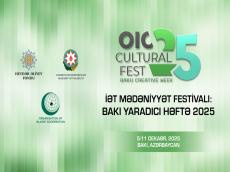
This year marks a significant milestone: for the first time, Azerbaijan is hosting the OIC Culture Festival: Baku Creative Week – 2025, organised in partnership with the Heydar Aliyev Foundation, the Azerbaijan Culture Ministry and the Organisation of Islamic Cooperation (OIC), demonstrating the country's growing leadership in strengthening cultural cooperation and unity across the Islamic world.
Since its inception in 2019, the OIC Culture Festival has been held in various member states, strengthening collaboration in culture and creative industries while promoting mutual understanding and friendship among peoples. The Baku edition continues this tradition, bringing together more than 300 official delegates and experts from 50 countries, alongside an expected 5,000 visitors. The festival reaffirms the shared values and unity of the Organisation of Islamic Cooperation (OIC).
Within the framework of Baku Creative Week – 2025, several major events are planned, including a high-level meeting of Culture Ministers from OIC member states, the Forum on Cultural and Creative Industries (MYFORUM), the Creative Village exhibition (MYEXPO), the international film program Baku Cinema Breeze – 2025, the Eastern Fashion Show featuring young and established designers from OIC countries, the G-HUB International Summit on Gaming Technologies, as well as diverse cultural projects in theater, music, dance, and animation.
Azerbaijan Culture Minister Adil Karimli has addressed the opening ceremony of the festival.
In his address, the Azerbaijani Minister emphasised that Baku Creative Week – 2025 is not only a celebration of cultural diversity but also a strategic initiative to strengthen Azerbaijan's role as a hub for creative exchange within the Islamic world. He noted that the festival’s comprehensive program, spanning cinema, fashion, gaming, music, and literature, reflects the dynamism of modern cultural industries and their growing impact on global development.
Minister Karimli pointed out that the event provides an opportunity for policymakers, industry leaders, and creative professionals to share experiences, explore innovative solutions, and build sustainable partnerships. He also stressed that Azerbaijan's commitment to cultural diplomacy is aligned with the broader goals of the OIC, which seeks to foster unity and cooperation among its member states through dialogue and shared values.
The Azerbaijani official concluded by expressing confidence that the outcomes of Baku Creative Week – 2025 would resonate far beyond Azerbaijan, contributing to the advancement of creative industries across the Islamic world and reinforcing the spirit of solidarity that defines the OIC community.
The role of Baku in hosting international events of global importance has also not gone unnoticed. Tarig Ali Bakheet, OIC Assistant Secretary-General for Humanitarian, Cultural and Social Affairs and Special Envoy of the OIC Secretary General on Afghanistan, said that Azerbaijan's initiative in hosting the OIC Cultural Festival: Baku Creative Week – 2025 reflects the country's growing role in shaping cultural diplomacy across the Islamic world. He added that Baku has become a meeting point where tradition and innovation converge, offering a platform for creative industries to flourish while strengthening the bonds of solidarity among OIC member states.
The Secretary General highlighted that the festival's diverse program demonstrates how culture can serve as a driver of economic growth, social cohesion, and international cooperation. By bringing together policymakers, artists, entrepreneurs, and young professionals, the event creates opportunities for dialogue and collaboration that extend beyond national borders.
Bakheet emphasised that the OIC Secretariat views such initiatives as vital for nurturing mutual respect and understanding among peoples, while also empowering youth to take an active role in cultural and creative development. He expressed confidence that the outcomes of Baku Creative Week – 2025 would contribute to building a sustainable cultural ecosystem across the Islamic world, reinforcing shared values and strengthening collective identity.
Concluding his remarks, Tarig Ali Bakheet stated that the festival is a testament to the vision of Azerbaijan and the OIC in promoting creativity as a cornerstone of human progress, and he expressed hope that the partnerships formed in Baku would inspire future projects that unite communities through culture and innovation.
Turkiye's Deputy Minister of Culture and Tourism, Nadir Alpaslan, emphasised that the festival functions not only as an artistic event but also as a significant means of reinforcing spiritual connections, mutual understanding, and shared historical memory among nations. He pointed out that the festival exemplifies how art can serve as a tool for fostering unity, noting that the fraternal relationship between Azerbaijan and Turkiye, grounded in the principle of "One nation, two states," serves as a model of cultural collaboration.
Alpaslan further stated that Turkiye is consistently willing to support initiatives that promote cultural cooperation, encourage youth participation in creative environments, and develop innovative approaches to presenting Islamic culture. He underlined that the measures taken within the OIC framework, the expansion of cultural platforms, and the growth of creative industries are of strategic significance for Turkiye.
He observed that Islamic culture has historically influenced every aspect of life in the region, from architecture and music to literature and science, and that today it is being shared with broader audiences through new technological platforms, creative ecosystems, and global cultural integration. He expressed the belief that the festival would contribute to both preserving historical heritage and enriching it through a contemporary perspective.
Finally, Alpaslan acknowledged Azerbaijan's leadership in cultural diplomacy and its contributions to regional solidarity, stating that these efforts are appreciated not only by Turkiye but by the entire Islamic world. He expressed confidence that cooperation in cultural projects would continue to expand in the coming years, introducing new initiatives and formats for cultural exchange.
Speaking at the inauguration of the OIC Cultural Festival: Baku Creative Week – 2025 in Baku, Pakistan's Federal Minister for National Heritage and Culture, Aurangzeb Khan Khichi, expressed that Pakistan, as a brotherly nation, took pride in Azerbaijan’s role as host of the landmark event. He stressed that Baku had become a cultural, creative, and intellectual platform for the Islamic world, providing new momentum to cooperation.
Khichi underlined that Pakistan is always willing to actively participate in initiatives that strengthen Islamic solidarity and promote shared cultural values. He explained that the festival should be seen not merely as an event but as a significant opportunity for cultural rapprochement, creative exchange, and strategic cooperation within the Islamic world. He stressed that the shared history, cultural roots, and religious unity of the Islamic nations bind them together not only symbolically but in genuine partnership, and Pakistan was committed to supporting cooperation at all levels to maintain and strengthen this unity.
He also highlighted that Azerbaijan's efforts in cultural diplomacy and its contributions to cultural cooperation at both regional and global levels were highly commendable. Aurangzeb Khan Khichi expressed the belief that such fruitful initiatives would continue, further reinforcing the cultural identity of the Islamic world.
Delivering remarks at the opening ceremony, Libya's Minister of Culture and Cognitive Development, Mabrouka Toghi, highlighted the significance of Azerbaijan's contribution to Islamic solidarity, noting that it was widely acknowledged and respected. She stated that Azerbaijan's efforts not only strengthen regional ties but also promote global cultural cooperation.
Mabrouka Toghi emphasised that the festival exemplifies these values, bringing together architects, artists, filmmakers, musicians, scholars, and young talents to share modern cultural developments, innovative ideas, and technological creativity. She pointed out that Islamic culture has historically served as a carrier of knowledge, science, art, and moral values, and that this heritage is reflected not only in libraries and museums but also in daily life, architecture, music, literature, and collective memory.
She added that the Libyan Culture Ministry is committed to continuing its work within the OIC framework to expand joint cultural programs, support the creative development of youth, and strengthen cooperation in knowledge and cognitive fields. Toghi also noted that creative industries are expected to become a key sector driving both economic and cultural development in the future.
Egypt's Culture Minister, Ahmed Fouad Hanno, highlighted that Azerbaijan plays an exemplary role not only in preserving cultural heritage but also as a center for creativity and cultural cooperation within the Islamic world. He stated that Egypt believes the initiative contributes to expanding cultural dialogue in the region, strengthening historical ties, and promoting shared spiritual values globally. He expressed confidence that the festival would provide an opportunity to showcase the cultural strength, creative potential, and contemporary cultural policies of the Islamic world to the world audience.
Hanno also noted that every creative participant, expert, and cultural institution involved in the festival contributes to a common mission: preserving cultural heritage, transmitting it to future generations, and enriching it with modern and innovative approaches. He emphasised that Islamic culture has historically been one of humanity’s most valuable sources of scientific and aesthetic heritage, and that this centuries-old legacy, which has united Islamic nations, now takes on a strategic role in further strengthening cultural relations.
He affirmed that Egypt is prepared to work jointly to develop this shared cultural environment for future generations in a more creative, sustainable, and inclusive way, noting that culture serves as one of the most powerful means of fostering mutual understanding, respect, and lasting peace. Hanno concluded by observing that Baku today functions not only as a festival venue but also as an international hub serving as a bridge between cultures.
The Baku Creative Week – 2025 shows how the OIC Culture Festival is evolving into more than a cultural showcase; it's becoming a platform for building networks and future opportunities. Moreover, Azerbaijan's hosting of the festival marks a step toward shaping a more connected and forward-looking OIC community.
URL: http://www.today.az/news/entertainment/263990.html
 Print version
Connect with us. Get latest news and updates.
See Also
- 31 July 2026 [11:39]
Karabakh University announces minimum admission scores for 2026/2027 - 30 July 2026 [10:23]
Nationwide celebrations planned for National Cinema Day - 30 July 2026 [09:00]
Ballet gala concert held at 15th Gabala International Music Festival - 30 July 2026 [02:48]
15th Gabala International Music Festival opens - 27 July 2026 [12:16]
Baku hosts ICESCO forum on strategic future studies and artificial intelligence - 27 July 2026 [11:25]
State Examination Center conducts music theory tests in three cities - 26 July 2026 [22:37]
Final trailer released for Spider-Man: Brand New Day [VIDEO] - 26 July 2026 [21:03]
LEGO unveils new SpongeBob SquarePants set - 26 July 2026 [19:34]
First look at Milo Manheim as Flynn Rider revealed from Disney’s live-action 'Tangled' set - 26 July 2026 [17:00]
Dream Fest 2026: Turkish singers receive stars on Sea Breeze Walk of Fame
Most Popular
 What caused last-minute delay in Iraq-Türkiye Development Road deal?
 Coca-Cola hits all-time high on nearly 7% surge
 Azerbaijan, Pakistan expand justice cooperation
 Ukraine downs 65 Russian drones overnight
 New poll finds 49% of Americans favor Netanyahu's arrest during U.S. trip
 Iran says those accepting its frozen funds won't pass via Hormuz
 Saudi Arabia confirms attack on militias in Iraq