|
|

TODAY.AZ / Business
Central Bank of Azerbaijan keeps interest rate corridor unchanged amid stable inflation
24 June 2026 [11:23] - TODAY.AZ
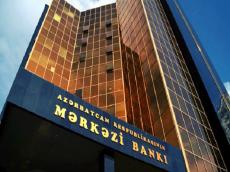
As anticipated by AzerNEWS, the Central Bank of Azerbaijan (CBA) has left all parameters of its interest rate corridor unchanged, citing stable inflation within the target range, geopolitical developments, trends in global financial markets, and domestic macroeconomic conditions.
In a statement, the CBA said annual inflation remains within the target range and is moving in line with the baseline forecast trajectory. Twelve-month inflation stood at 5.6 percent in May 2026.
Annual price growth reached 6.6 percent for food products, alcoholic beverages and tobacco products, 5.7 percent for paid services, and 3.9 percent for non-food products. Core inflation also amounted to 5.6 percent.
The foreign exchange market remained favorable during the first five months of the year, with supply exceeding demand in both cash and non-cash segments. Exchange offices purchased $311 million more in foreign currency than they sold during the period.
The dollarization level of deposits held by resident individuals declined by 2.8 percentage points over the past 12 months, falling to 27 percent in May 2026. Meanwhile, money transfers into Azerbaijan increased by 28.8 percent year-on-year to $560.1 million in January-May.
Against the backdrop of a significant decline in banks' demand at foreign exchange auctions, the Central Bank carried out foreign currency purchase interventions. As a result, the CBA's foreign exchange reserves rose by $1.2 billion, or 10.4 percent, during the first five months of the year, reaching $12.7 billion.
External sector indicators also remained strong. According to customs statistics, Azerbaijan posted a foreign trade surplus of $7.2 billion in January-May 2026. The Central Bank expects a further improvement in the current account surplus by the end of the year, driven by higher global energy prices and continued positive trends in non-oil and gas exports.
The CBA noted that short-term interest rates in the unsecured money market continue to form within the interest rate corridor and remain close to the policy rate. Since the end of March, the average daily AZIR rate has fluctuated between 6.43 percent and 6.44 percent.
In an environment of excess liquidity, the Central Bank has primarily relied on seven-day deposit operations to keep the AZIR rate close to the policy rate. By the end of May, these operations accounted for 88.7 percent of the sterilization portfolio under open market operations.
The regulator also conducts regular auctions for the placement of its notes. Yields on notes across all maturities declined in May and June, while excess liquidity in the banking sector is expected to increase further during the remainder of the year.
The Central Bank maintained its forecast that annual inflation will remain within the target range this year and next year. However, it warned that external inflationary pressures have begun to intensify.
According to the CBA, rising global food and fertilizer prices, increasing transportation and logistics costs, higher inflation imported from trading partner countries, and a slower pace of appreciation in the nominal effective exchange rate could heighten external inflation risks.
The bank stressed that future decisions on the interest rate corridor will continue to depend on inflation forecasts and macroeconomic developments, while several economic scenarios will be assessed given ongoing global uncertainties.
The Central Bank also announced a change to its 2026 monetary policy calendar. The next decision on the interest rate corridor and the accompanying press conference have been moved from August 5 to July 31, 2026. A meeting with experts is also scheduled to take place on the same day.
URL: http://www.today.az/news/business/268554.html
 Print version
Connect with us. Get latest news and updates.
See Also
- 15 August 2026 [17:35]
Nakhchivan’s investment boom points to broader economic transformation - 14 August 2026 [19:15]
Azerbaijan seeks to turn aluminum into pillar of industrial diversification [ANALYSIS] - 14 August 2026 [16:07]
Azerbaijan, China’s CITIC Group discuss $1.5 billion-scale AI computing platform [ - 14 August 2026 [13:11]
Kazakhstan increases oil shipments to BTC pipeline via Aktau port - 14 August 2026 [12:54]
Azerbaijan's Ismayilli-1 Hydropower Plant generates 39.8 million kWh of electricity - 13 August 2026 [20:14]
Baku and Yerevan seek to turn peace into economic interdependence - 13 August 2026 [17:28]
Azerbaijan facilitates transit of Russian wheat to Armenia - 13 August 2026 [15:28]
Azerbaijan, China discuss expanding cooperation in metallurgy - 13 August 2026 [13:39]
Azerbaijan explores new directions for financial technology development - 13 August 2026 [12:03]
Fitch Ratings praises Azerbaijan’s banking reforms under Basel III
Most Popular
 Intricacies of energy security: why region cannot do without Zangezur transmission line
 Rainy weather expected in country's regions
 Azerbaijan facilitates another Russian grain shipment to Armenia
 Kazakhstan increases oil shipments to BTC pipeline via Aktau port
 Azerbaijan, China’s CITIC Group discuss $1.5 billion-scale AI computing platform [
 Azerbaijan seeks to turn aluminum into pillar of industrial diversification [ANALYSIS]
 Caspian Sea at turning point after two decades of environmental cooperation