|
|

TODAY.AZ / World news
China’s asteroid defense breakthrough
04 August 2026 [08:00] - TODAY.AZ
By Alimat Aliyeva
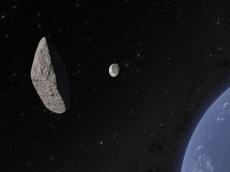
A team of researchers from the Chinese Academy of Launch Vehicle Technology (CALT) has proposed a new two-stage method for dealing with large asteroids that could potentially threaten Earth, AzerNEWS reports.
The proposed strategy involves using a high-speed metal projectile to create a deep crater on the asteroid’s surface. In the second stage, a spacecraft would deliver a nuclear device into the crater and trigger a controlled underground explosion. Scientists believe that placing the explosive charge beneath the surface could significantly increase the effectiveness of the impact compared with a simple surface explosion.
According to a report published in the journal Space: Science & Technology, computer simulations show that a 3-megaton nuclear explosion — roughly equivalent to the power of about 200 Hiroshima bombs — could completely break apart an asteroid around 100 meters in diameter. The researchers also discovered that placing the charge approximately 30 meters below the asteroid’s surface could more than triple the asteroid’s trajectory change compared with a shallow explosion.
This approach could provide a more powerful alternative to traditional asteroid-deflection methods, which usually focus on gently changing an asteroid’s path rather than destroying it. One example of such technology is NASA’s DART mission, which successfully tested the ability to alter the orbit of a small asteroid moon by using a spacecraft impact.
However, scientists emphasize that using nuclear devices in space would be a last-resort option. The main goal of planetary defense programs is to detect potentially dangerous objects as early as possible and redirect them safely before they become a serious threat.
With thousands of near-Earth asteroids being monitored by space agencies around the world, developing reliable defense strategies remains an important challenge for modern astronomy and space exploration.
URL: http://www.today.az/news/regions/269236.html
 Print version
Connect with us. Get latest news and updates.
See Also
- 04 August 2026 [13:16]
Lebanon prepares for next round of talks with Israel in Rome - 04 August 2026 [11:01]
U.S. plans to close five diplomatic missions abroad - 04 August 2026 [10:23]
Kyrgyzstan, Uzbekistan begin official transfer of border villages - 04 August 2026 [09:00]
“New Spider-Man breaks Avengers’ first-day box office record” - 04 August 2026 [08:00]
China’s asteroid defense breakthrough - 03 August 2026 [23:30]
Ancient 2,500-year-old statue unearthed in Turkiye - 03 August 2026 [22:59]
Australia to tax tech giants over media payments - 03 August 2026 [21:53]
ArcelorMittal and Microsoft advance cloud innovation - 03 August 2026 [13:58]
Iran seeks deal with Oman to ensure safe passage through Hormuz - 03 August 2026 [13:17]
Nikol Pashinyan names former US Ambassador Lilit Makunts Chief of Staff
Most Popular
 Japan earthquake damages over 4,600 homes in Kumamoto
 Armenian Railway Crisis: TRIPP and Real sovereignty
 Hungarian PM warns of 'critical' days as nuclear plant shuts
 World Bank's latest assessment brings new perspective on Baku's challenge in human capital reform
 Ukraine faces critical shortage of Patriot air defense missiles
 Heatwave drives €3.1 billion wildfire damage across Europe
 Lula registers as candidate for Brazilian elections