|
|

TODAY.AZ / Politics
Babakyar and delimitation: how Azerbaijan defended its strategic frontiers
11 September 2026 [13:13] - TODAY.AZ
News about the delimitation of the state border between
Azerbaijan and Armenia is among the most anticipated. Six years have passed
since the war, and to date, only 13 kilometers out of more than 1,000
kilometers of the border line have been delimited and demarcated. This means
that the borders between the two states, which have been in a serious conflict
for many years, remain in a provisional status.
At the same time, it is clear to everyone that the border,
which was destroyed by Armenia along almost its entire length, cannot be
restored quickly. Over the thirty years of the conflict, the Armenian side has
encroached on the sovereign territories of Azerbaijan, and now these weeds will
have to be uprooted, which will not always be a painless process. There is
already positive experience in this regard. In April 2024, the demarcation took
place on a 12.7-kilometer section of the state border after four villages of
the Gazakh region were returned to Azerbaijan - Baganis Hayrim, Ashagi
Askipara, Kheyrimli and Gyzylgajili. At the same time, the demarcation was
carried out without delay. Both processes were going on almost in parallel.
Azerbaijan did not give the Armenian side the opportunity to change its mind or
slow down the process. Despite the agreements with official Yerevan, the
revanchist opposition and the church did everything they could to hinder the
liberation of the occupied Azerbaijani villages. The domestic political
situation in Armenia deteriorated sharply and threatened to escalate into mass
unrest. The opposition actively campaigned against the government’s decision,
urging Armenians who had been living illegally in the seized villages for
decades not to agree with it. To the credit of official Yerevan, it managed to
handle the situation, and the delimitation process ended without serious
incidents.
So, as of today, only 13 kilometers of the Azerbaijani?Armenian border can be
considered non?contested.
The societies of the two countries are waiting for the process to continue.
The day before, Azerbaijani Foreign Minister Jeyhun Bayramov
said that the parties had reached an agreement on the direction in which the
delimitation would continue. “There is an understanding that the work will
begin in the more challenging northern section — from the point where the
borders of Azerbaijan, Armenia, and Georgia meet — and will move from
north to south,” the minister told reporters.
Previously, two options were considered: the section
announced by the head of the department and the section of the border in the
south, from which the TRIPP utilities will run.
In Armenia, they do not rule out that the plans may change.
Commenting on the statement made on Wednesday by the head of the Azerbaijani
Foreign Ministry, Sargis Khandanyan, head of the Armenian parliament’s foreign
relations committee, said that the implementation of TRIPP may lead to changes
in the schedule for the delimitation of the Armenian?Azerbaijani border. When the
implementation of the “Trump Route” begins on the ground, there is a possibility that partial
delimitation work will be carried out, for example, on those sections where a
railway is supposed to run, or on the section where oil pipelines, gas
pipelines, and power lines are to be laid. “That is, perhaps, I won’t say a
deviation, but a certain change in logic regarding very local sections. But the
overall logic is, of course, from north to south,” the parliamentarian noted.
If the peace agenda between the two countries continues to
progress in the same vein as it does today, it is possible that the
delimitation of borders will take place simultaneously in several areas. Since
the construction of cross?border
infrastructure without border delimitation is impossible.
Some believe that it has been decided to start the process
in the north because there are not many problems there and the work will be
easy. However, this is a mistaken view.
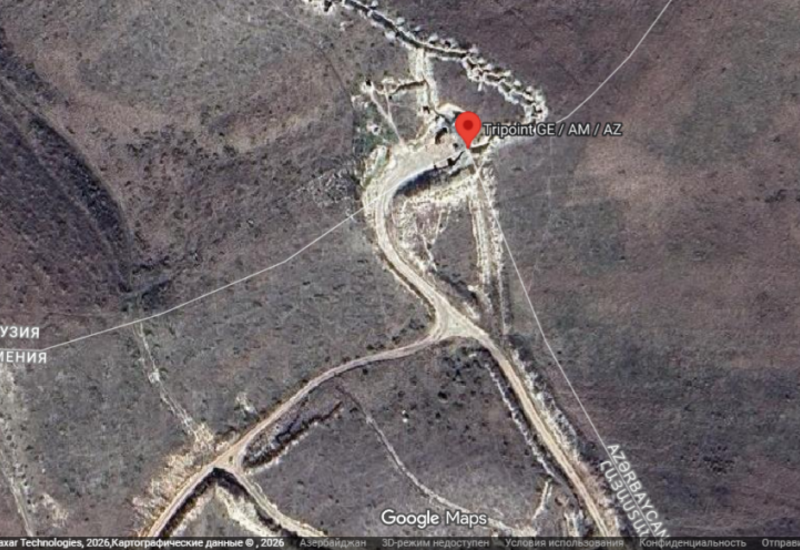
The point where the borders of Azerbaijan, Armenia, and
Georgia intersect (the triple junction) is located on the south?western slope of the
Babakyr mountain range. This strategic height, according to the
administrative-territorial division, is located in the area of the village of Ikindji
Shikhly, Gazakh District, Azerbaijan. The closest village to the very point of
the junction is the Georgian village of Tekali in Marneuli. At one time,
communications from Azerbaijan to Armenia passed through this strategically
important area. In particular, a railway and a gas pipeline. With the start of
Armenian aggression, these communications were cut off.
During the conflict, the Armenian side repeatedly attempted
to advance its positions towards the strategic Babakhar height. The only thing
that prevented serious armed provocations was the fact that the border with
Georgia also ran through this area. Dominating this height provided a complete
operational and tactical advantage over the adjacent territories. The
Azerbaijani armed forces have held the position on the hill since the early
1990s. Until December 2018, units of the Ministry of Defense were stationed
along the border; then this section came under the control of the Border
Service. In the summer of 2019, Azerbaijani border guards had to repel an
attack by the Armenian armed forces, which were attempting to advance deeper
into the border zone. In response, the State Border Service of Azerbaijan
carried out a counter?operation
and advanced its combat posts by 1.5–1.7
kilometres. Four new strategic heights on the Babakhar ridge were occupied.
This allowed Azerbaijan to take full visual and fire control over critical
infrastructure — the transit gas pipeline running from Georgia to Armenia
and the gas distribution station. Additional security was also provided for the
border Azerbaijani villages..
The safety of the border Azerbaijani villages was needed
even in areas not adjacent to the occupation zone. There was an incident when,
after Armenians fired on a wedding procession in one of the border villages,
the residents turned to the military, and they took action — they
took control of the enemy’s position from which the threat was coming. The same
was done in 2019 in the direction of Babakyar, the point where the borders of
three states meet. Although this place was far from the occupation zone, people
also died there.
After the prevention of the Armenian attack and the
advancement of Azerbaijani positions, the Armenian Ministry of Defense, as
usual, issued a denial, stating through the department’s chief propagandist,
Artsrun Hovhannisyan, that “the process of improving Armenian positions is
ongoing, and this also applies to the Nakhchivan direction.” This statement
amused the Azerbaijani side, because the reality was different: the actions of
the army of the occupying country were monitored both visually and using
special technical surveillance equipment.
It is clear that the Armenian side perceived the latest
defeat in the border clashes as painful and nerve?wracking. The Armenian side did not want to admit the
failure of its plans and tried to shift the problem onto Georgia and present
what had happened as “Azerbaijan’s invasion of Georgian territory.” In November
2019, the British resource Bellingcat published an article with a corresponding
headline. The fake was concocted based on a satellite image. Why are we not
surprised? A certain journalist from the Armenian diaspora in Australia and
some experts from Armenia launched a fake “investigation,” claiming that
Azerbaijani border guards had allegedly occupied not Armenian positions, but
Georgian territories — as much as 200 hectares. At the same time, for some
reason, no protests were voiced by the Georgian side. But this fact did not
bother the authors of the fake in the slightest.
Azerbaijan’s border outposts in the area marked on maps as
Tripoint GE/AM/AZ are located on sovereign Azerbaijani territory. Meanwhile,
sources on social media indicate that a little further south, in an undelimited
section of the same zone, there is an Armenian position with one foot on
Azerbaijani territory. If this is indeed the case, then Yerevan must be
prepared to address this issue.
Meeting with voters at the end of May, Prime Minister Nikol
Pashinyan stated that there are two possible approaches to the issue of
delimitation: “either the parties proceed from a confrontational logic and
allow for the emergence of new crises in the future, or they decide to finally
resolve historical disputes and establish the border in such a way that it does
not create new grounds for tension.” According to the Armenian prime minister,
the basic principle of delimitation is the borders of the former USSR and the
Alma?Ata
Declaration, “however, if a strict border line
creates inconveniences for people’s lives, it
may be adjusted as part of optimization.”
Azerbaijan is fully in favor, but with some clarifications.
There are no historical territorial disputes between Armenia
and Azerbaijan. There are territorial claims by Armenia against Azerbaijan, and
this is a completely different level of the problem. Also, the issue of
“inconvenience” is not relevant to the Azerbaijani population, because
Azerbaijani villages do not extend beyond the borders of their country and will
not experience any inconvenience from the delimitation. However, during the
years of occupation, the Armenians moved their borders, their farms, their
houses, their arable land, and their wells onto the sovereign territory of
Azerbaijan. It goes without saying that the Armenian population may suffer
losses, just as Armenian citizens suffered losses during the 2024 delimitation.
The restoration of legitimate borders will continue to cause many of the very
inconveniences that Pashinyan spoke about. Having grown accustomed over decades
to the absence of borders, the residents of the Armenian borderlands complain
to journalists and revanchists that they are very frightened by the Azerbaijani
positions located two kilometers away. They say they can’t graze their sheep
where they’re used to because the Azerbaijani people have “taken away” the
pastures.
Should Baku take these inconveniences into account and move
the border so that Armenian children won’t be afraid of seeing the Azerbaijani
flag flying high?
It seems these questions don’t require an answer.
URL: http://www.today.az/news/politics/270150.html
 Print version
Connect with us. Get latest news and updates.
See Also
- 14 September 2026 [10:10]
Will European concessions save the Armenian economy? - 11 September 2026 [13:13]
Babakyar and delimitation: how Azerbaijan defended its strategic frontiers - 11 September 2026 [11:01]
US congressman says Armenia-Azerbaijan peace deal could be signed during Trump’s term - 10 September 2026 [14:36]
President Ilham Aliyev approves state program for ensuring food security in 2027?2032 - 10 September 2026 [12:00]
President Ilham Aliyev attended opening of paper and hygiene products manufacturing facility in Garadagh district - 10 September 2026 [10:10]
Azerbaijan strengthens its position in Caspian Sea - defense power comes into play - 09 September 2026 [14:23]
Azerbaijan reaffirms unwavering support for Türkiye ahead of COP31 - 09 September 2026 [12:15]
President Ilham Aliyev congratulates President of Tajikistan - 09 September 2026 [11:11]
TRIPP: ring is calling… - 08 September 2026 [14:14]
Masochism and diaspora: how Armenian community reminds world of its crimes
Most Popular
 Turkey’s Fidan to visit Syria for talks on security, trade and energy
 UK pushes back after Trump backs united Ireland
 Over 200,000 bee colonies find new home in Azerbaijan’s liberated territories
 Putin-Zelensky meeting ruled out at G20 summit in Miami
 Iran sets seven conditions for reopening Strait of Hormuz
 At least 21 Arabs reportedly arrested in Iran's Khuzestan province
 Elite and St. Moritz to clash in Sea Breeze 2026 beach polo final