|
|

TODAY.AZ / Politics
EU recognizes unique role of Azerbaijan
03 July 2026 [12:12] - TODAY.AZ
While some European parliaments are voting against
Azerbaijan, the relations between Baku and the European Union are opening a
qualitatively new chapter. And this happens at such a level that any attempts
to strike at the relations of the parties obviously turn into nothing.
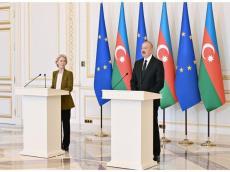
President of the European Commission Ursula von der Leyen
paid a visit to Baku on the first day of July. This politician has always
advocated expanding contacts with Azerbaijan, for which she has repeatedly been
fiercely criticized in the lobbying circles of the European Union. Despite the
pressure, her line won, and after another meeting with President Ilham Aliyev
and the statements made in Baku, we can safely say that EU-Azerbaijan relations
will never be the same again. They have moved to a new level, when the
Baku-Brussels axis becomes an axis on which not only bilateral interests will
be strung. The political, transport, and energy interests of the South
Caucasus, Europe, and Central Asia will be here. And if we look at the issue even
more broadly, the fate of regional transport connectivity and energy security
between East and West will depend on the interaction between Azerbaijan and the
European Union.
It became clear that relations that had cooled due to the
efforts of certain EU circles were awaiting a reset when it was announced last
April that the European Union and Azerbaijan had agreed to resume negotiations
on a new partnership and cooperation agreement. It was an initiative of the
European side. During her first visit to Baku and meeting with President Ilham
Aliyev, the new EU High Representative for Foreign Affairs and Security Policy,
Vice-President of the European Commission, Kaia Callas, made it clear that she
had come not only for gas and corridors, but also for straightening relations
that had suffered greatly during the Josep Borrell era. The former head of
European diplomacy chose the wrong and ineffective line of conversation with
Baku and damaged the image of the EU in the eyes of Azerbaijani society.
Attempts of pressure and blatant application of double standards by European
officials and some leading EU countries have created a negative aura that has
not contributed to the development of ties.
In a press statement after meeting with Ms. von der Leyen on
Wednesday, Ilham Aliyev said that relations between the European Commission and
Azerbaijan are currently in a very active phase.
President of the European Council Antonio Costa was received
in Baku in March, and Kai Callas paid another visit in May. The current visit
of the head of the European Commission, which is not the first, closes this
ring. All EU leaders voted for the development of relations with Azerbaijan and
recognized its strategic importance for Europe. With one small exception, there
is also the President of the European Parliament, Roberta Matsola, who stands
out from this row. But no one listens to the decisions of the EP.
Any decisions taken against Azerbaijan are shattered by the
importance that our country has already established. There are too many ties
between Azerbaijan and the European Union, and this interest is
reciprocated.
"The European Union is Azerbaijan's main trading
partner. More than 40 percent of our trade turnover is accounted for by the EU
member states, and Azerbaijan is the main trading partner in the South Caucasus
for the European Union. Almost 70 percent of trade in the South Caucasus is
accounted for by trade with Azerbaijan," President Ilham Aliyev said in
his speech after meeting with von der Leyen.
The Head of State recalled the Memorandum of Understanding
on Strategic Partnership in the energy sector, signed in July 2022. Having
found itself in a difficult situation in terms of energy security after the
outbreak of the war in Ukraine, the European Union found an alternative in
Baku. And an alternative that is very reliable, independent, proactive and
stable. Over the past four years, Azerbaijani gas exports to the European Union
have increased by almost 65 percent. This is a very good indicator, proving
that the European Union made the right choice in 2022. Currently, 10 EU member
states receive Caspian gas, and, as the Azerbaijani leader noted, there is
potential for expanding this geography. Azerbaijani gas goes to European
partners through a pipeline system with a total length of 3,500 kilometers.
Another item on the bilateral agenda was green energy and
Baku's initiative, which transformed the Black Sea Energy (Black Sea Energy
Corridor) project from an interregional to a continental one through
integration with the Trans-Caspian Energy Corridor. Baku always thinks broadly,
and any initiative within the republic focuses on the prospect of reaching out
to its neighbors and neighbors. As President Ilham Aliyev once said, the
success of Azerbaijan's projects is determined by the fact that it has good
relations with its neighbors and with the neighbors of its neighbors. This is a
very correct formula, which today works for the interests of the energy and
transport corridors in which Azerbaijan participates. And no one today will
deny his special role in this space.
This role was once again confirmed by Ursula von der Leyen during her current visit. One could see how inspired the European official was by the results of the negotiations with the President of Azerbaijan. According to her, as part of the existing Global Gateway investment program, the EU will allocate up to 200 million euros in grants for the development of transport, energy and digital communications in the South Caucasus. Among the projects may be, for example, a railway connection through Nakhchivan and the development of the Baku port.
It should be recalled that the issue of European investments
in the railway modernization project of the Nakhchivan Autonomous Republic was
raised at the meeting of the President of Azerbaijan with the European
Commissioner for Enlargement Marta Kos on the sidelines of the Davos Forum.
Later, at a meeting between the Minister of Digital Development and Transport
of Azerbaijan Rashad Nabiyev and the Director General of the European
Commission's Directorate General for Enlargement and the Eastern Neighborhood,
Gert Jan Koopman, the preparation of a feasibility study for the project was
discussed.
The EU's decision to participate in the reconstruction of
the Nakhchivan railway network can be viewed in the logic of the EU's
accession, so far in absentia, to the Azerbaijani initiative of the Zangezur
Corridor. The EU does not want to stand aside.
The South Caucasus is one of the world's greatest transport
hubs connecting Europe, the Caspian region and Central Asia, von der Leyen
said. Its strategic importance continues to grow, and Azerbaijan has a central
role to play in this process. "Few countries have a position as
advantageous as yours to promote regional cooperation and stability. Azerbaijan
skillfully combines its strategic geographical position with its growing
economic, political and regional influence," the head of the European
Commission acknowledged.
Indeed, Azerbaijan has a very advantageous geographical
location. Meanwhile, not only our country is well located on the map. But few
people know how to use this factor so productively to benefit themselves and
their partners. That is why the EU intends to hold a Regional Conference on
Investments in Transport Connectivity here. And where else? This is where
Europe, the South Caucasus and Central Asia connect. Azerbaijan is the central
link of the vast majority of transport and logistics routes on this continent.
Especially in the current geopolitical situation, which has completely redrawn
the scheme of traditional routes.
On Thursday, the EC President arrived in Yerevan. In Baku, she called the peace process between Azerbaijan and Armenia the most important event in the region in recent decades. She stated that the European Union strongly supports this process. And not only in words, but also financially. After meeting with the President of Azerbaijan, she announced a new peace consolidation program with a budget of 20 million euros. According to the European official, these funds will be used for programs in the border regions. It should be understood that we are talking about the border regions not only of Armenia. Previously, the EU had allocated funds only to the needs of the Armenian side. Now, the European Union intends to adjust its steps towards a balanced approach. This is commendable and right. Especially against the background of the unilateral steps that Baku has taken to make its neighbor feel all the advantages of peaceful coexistence. Today, there is a unique situation that opens up great opportunities for the region. The European Union can successfully fit into this scenario. Not unilaterally anymore. Not as some kind of observation mission with dubious goals. And as a partner who is really interested in peace and development.
It should be noted that the EU's agenda with Armenia is
fundamentally different from that implemented by the European Union with
Azerbaijan. Baku and Brussels are almost equal partners, connected primarily by
economic interests and promising projects. Baku does not ask for anything from
Europe and does not seek to join the EU. Armenia is in dire need of support,
primarily political support. However, economic assistance in connection with
Russia's refusal from Armenian imports is now on the agenda. Yerevan has set
the goal of integration into the EU and expects to break away from the
traditional Russian influence with the assistance of the Europeans. The
situation in connection with these processes is quite tense, and now the task
of the European Union is to assert its rights to Armenia, but in such a way as
to prevent a repeat of the Ukrainian scenario.
And even in this work, the EU cannot do without cooperation
with Baku.
URL: http://www.today.az/news/politics/268728.html
 Print version
Connect with us. Get latest news and updates.
See Also
- 03 July 2026 [12:27]
President Ilham Aliyev sends congratulatory letter to President of Belarus - 03 July 2026 [12:12]
EU recognizes unique role of Azerbaijan - 02 July 2026 [15:34]
Von der Leyen backs South Caucasus peace with €2 bln connectivity vision - 02 July 2026 [10:50]
President Ilham Aliyev receives Minister of Justice of Türkiye - 02 July 2026 [09:26]
European Commission President concludes visit to Azerbaijan - 01 July 2026 [12:54]
President Ilham Aliyev congratulates President of Somalia - 01 July 2026 [12:39]
President Ilham Aliyev sends congratulatory letter to Governor General of Canada - 01 July 2026 [12:21]
The passport issue spoiled the mood: Karapetyan threw a tantrum at journalists - 01 July 2026 [12:12]
Paris wanted to enter the Middle East without knocking – and got it from Tehran - 30 June 2026 [14:23]
Azerbaijan, Armenia launch anonymous reporting drive on missing persons
Most Popular
 Paris wanted to enter the Middle East without knocking – and got it from Tehran
 Massive Russian overnight assault devastates Kyiv, casualties expected to rise
 Europe remains critical hub for U.S. military operations, Rutte says
 Ukraine expands deep-strike campaign with attacks on Russian military sites
 Ukraine seeks French license to produce SCALP cruise missiles
 Baku hosts NATO training program focused on modern military standards
 Azerbaijan's digital reform takes centre stage in next growth strategy