|
|

TODAY.AZ / Arts & Entertainment
Experience Lachin through its heritage and landscapes
26 August 2026 [14:15] - TODAY.AZ
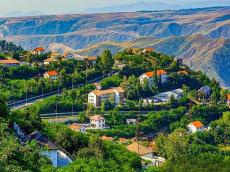
Lachin has a character all its own, a place where dramatic mountain scenery, centuries-old heritage and a renewed cultural life come together.
Forests cover the slopes, rivers wind through narrow valleys, mineral springs emerge from the mountains, and historic monuments preserve traces of the region's long and varied past. At the same time, new cultural venues, tourism facilities, roads and public spaces are giving the city a new chapter in its history. Few destinations in Azerbaijan bring together such a remarkable combination of mountain landscapes, historical heritage and cultural activity.
Lachin is a mountain city in southwestern Azerbaijan and the administrative centre of Lachin District, which was established in 1930. The city was known as Abdallar until 1923. Its mountainous geography has played an important role in shaping both its history and way of life. Lachin is steadily developing as a destination for cultural tourism, mountain recreation and international cultural events.
August 26 has a particular place in the city's modern history. Lachin, together with the villages of Zabukh and Sus, came under Azerbaijani control on August 26, 2022, and the date is now marked as Lachin City Day. Since then, extensive reconstruction has transformed the city, while the return of former internally displaced residents has brought community life back to the region.
Nature is one of Lachin's greatest attractions. The district is known for extensive forests, protected areas, rich flora and fauna, mineral springs and the rare red ironwood tree. The Hakari and Zabukh rivers meet near Zabukh, creating an especially scenic setting for visitors. The surrounding landscape offers opportunities for hiking, trekking, walking and camping, while the villages provide different ways to experience the mountain environment.
The cultural heritage of Lachin is equally varied. The district is home to ancient religious monuments, medieval cemeteries, burial mounds, caves and distinctive stone monuments. Among the best-known sites are the Aghoghlan monument, Damrovlu Pir Temple, Kar Kunbez Mausoleum and Ushag Castle. Medieval ram- and horse-shaped stones are another distinctive feature of the local historical landscape. The district also contains numerous other religious and archaeological sites that reflect different periods of settlement and cultural development.
Aghoghlan is particularly important within the region's architectural heritage. Located beside the Aghoghlan River, the ancient monastery is regarded as one of the notable examples of Caucasian Albanian architecture in Azerbaijan. Built of basalt stone, it is distinguished by its stone columns, narrow windows and vaulted interior.
Lachin's heritage is not confined to stone monuments. Traditional crafts are another important part of its cultural identity. The Gasimushaghi carpet is closely associated with the district and belongs to the wider Karabakh carpet-weaving tradition. Azerbaijan's carpet weaving was inscribed on UNESCO's Representative List of the Intangible Cultural Heritage of Humanity in 2010, recognising the importance of the craft and the knowledge passed from one generation to another.
The villages surrounding Lachin add another dimension to the cultural landscape. Zabukh, situated at the confluence of the Hakari and Zabukh rivers, is suited to hiking and offers visitors the possibility of experiencing village life. During the summer, local residents can offer their homes as guest accommodation. Husulu combines mountain scenery with trekking and camping opportunities and is known for the Hamza Sultan Palace.
Mirik is particularly interesting for travellers interested in geology and natural formations. The village has caves such as Garanlig Kaha, or Dark Cave, and Baygara, as well as waterfalls, volcanic rock formations and unusual cone-shaped rocks and stone columns. The Aghbulag, Peri Bulag and Chichek Bulag springs add to the area's natural appeal and give it potential for wellness tourism.
Sus offers another mountain landscape, with green valleys and volcanic formations, while Beylik combines a quiet rural setting with opportunities for walking, hiking and camping. These villages make Lachin more than a city destination. Together, they form a broader travel experience in which nature, heritage and local life are closely connected.
Lachin's cultural profile received international attention in 2025, when the city was designated the CIS Cultural Capital. The designation gave Lachin a year-long programme of cultural activities involving Azerbaijan and other CIS countries. The programme included exhibitions, performances, cultural meetings and culinary presentations.
One of the events held as part of the programme brought together confectioners from several CIS countries. Alongside traditional sweets, Azerbaijani national confectionery was presented together with the country's tea culture. Such events gave Lachin a chance to present local traditions while placing them within a wider regional cultural setting.
Lachin City Day has also become an important public occasion. Cultural programmes and celebrations held around the Hakari River have brought residents and visitors together in one of the city's most attractive natural settings. Such events are gradually giving the reconstructed city its own contemporary rhythm.
The region's tourism infrastructure has developed at the same time. Lachin International Airport, inaugurated on May 28, 2025, is the third international airport built in Azerbaijan's liberated territories. Built in difficult mountainous terrain, the airport provides a new gateway to Lachin and the surrounding districts and is expected to support tourism, business and wider economic activity.
Another important addition is the Lachin Recreation Complex in Zerti village. Opened in May 2025, the complex covers 11.2 hectares and has a built-up area of 42,000 square metres. It includes a 120-room hotel, eight cottages and accommodation for up to 324 guests. The complex also has a 500-seat event hall, a 340-seat banquet hall and a 100-seat conference room, making it suitable for cultural gatherings, conferences and other events as well as leisure travel.
Its recreational facilities include hiking and cycling routes, football and basketball pitches, bowling, billiards, karaoke, virtual-reality entertainment and a children's centre. Restaurants and cafés offer Azerbaijani and international cuisine. The complex also has a local employment dimension, with many of its employees coming from Lachin, Kalbajar and other liberated territories.
Food offers another way to understand Lachin and the wider Eastern Zangazur region. Mountain cuisine makes extensive use of local herbs, dairy products, meat and seasonal ingredients. Dishes such as chashyr govurmasi, prepared with wild herbs, onions, butter and eggs, and chepish buglamasi, a slow-cooked goat dish, reflect the ingredients and traditions of mountain communities.
For visitors, regional food can be as revealing as a historic monument. It tells the story of what grows in the mountains, what local families have traditionally prepared and how food has been shaped by the landscape.
The city is also gaining new spaces dedicated to history and remembrance. The Occupation and Victory Museum Complex is planned on a 3.5-hectare site and includes museum buildings and a Memorial Park. The project envisages displaying surviving elements of destroyed historical and cultural monuments in an open-air setting, creating a place where the region's recent history can be presented alongside its broader cultural heritage.
For travellers, Lachin can therefore be approached in several ways. It can be a destination for mountain walks and camping, a journey through Azerbaijan's architectural and archaeological heritage, an opportunity to discover traditional cuisine and crafts, or part of a wider journey through Karabakh and Eastern Zangazur.
Travel access has also become easier for international visitors. Since July 23, 2025, foreign citizens have been permitted to visit Lachin and other liberated territories either by private vehicle or as part of organised groups, provided they obtain the necessary permission.
What makes Lachin particularly compelling is the way its different layers exist side by side. Ancient monuments rise from a landscape of forests and mountains. Village traditions continue alongside new tourism facilities. Regional cuisine is finding a place in modern hospitality, while festivals are giving the city an increasingly active cultural calendar.
Lachin is therefore becoming more than a reconstructed city. Its mountains, rivers, monuments, villages, crafts, cuisine and cultural events are forming the foundations of a distinctive tourism identity. Its appeal lies not in a single landmark, but in the experience created by all these elements together: a mountain landscape with a deep past, a strong cultural character and a city entering a new period of life.
URL: http://www.today.az/news/entertainment/269777.html
 Print version
Connect with us. Get latest news and updates.
See Also
- 26 August 2026 [14:15]
Experience Lachin through its heritage and landscapes - 26 August 2026 [13:05]
SALAM Int'l Youth Film Festival opens in Baku - 25 August 2026 [14:16]
International guests explore National Art Museum - 25 August 2026 [13:35]
MyStart scholarship provides support for audiovisual arts students abroad - 25 August 2026 [12:08]
Carpet Museum showcases cultural heritage at Budapest Folk Art Festival - 25 August 2026 [10:21]
Leyla Aliyeva views works from first Bukhara Biennial - 23 August 2026 [10:00]
TÜRKSOY marks 20 years of photographers’ meetings with Budapest exhibition - 21 August 2026 [12:03]
Jackie Chan receives one-of-a-kind backgammon set - 21 August 2026 [11:12]
World-renowned supermodel Naomi Campbell heading to Baku - 20 August 2026 [15:00]
Khan Shushinski's musical legacy highlighted in Baku
Most Popular
 Tesla recalls nearly 3 million electric vehicles in China over safety risks
 Barcelona interested in Leipzig defender Castello Lukeba
 Putin, Trump could meet at APEC summit in China: Kremlin
 Peace through strength, Taiwan president says on China battle anniversary
 Sudan says it downed 'hostile' drone in Blue Nile state
 Pope calls for more efforts to stop Ebola in DR Congo
 Saudi space economy set to nearly quadruple to $31.6bn by 2035