|
|

TODAY.AZ / Arts & Entertainment
Archaeologists shed light on Taglar Cave's ancient human history
10 August 2026 [14:37] - TODAY.AZ
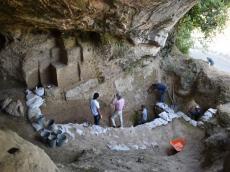
The third season of joint Azerbaijani-Japanese archaeological research is underway at Taglar Cave in Boyuk Taglar village, Khojavand district, AzerNEWS reports citing the Azerbaijan National Academy of Sciences.
The research began on July 25 and is being conducted under an agreement signed in 2023 between the Institute of Archaeology and Anthropology of the Azerbaijan National Academy of Sciences (ANAS) and the University of Tokyo.
The cave was first recorded in 1960 by Mammadali Huseynov, the founder of Paleolithic studies in Azerbaijan.
As a result of intermittent research conducted between 1964 and 1986, two-thirds of the cave's existing deposits were studied. More than 9,000 archaeological artifacts were discovered in the six cultural layers identified, the vast majority of which date back to the Middle Paleolithic period.
As is known, following the occupation of the Khojavand district by the Armenian armed forces, Azerbaijani archaeologists were unable to continue their research in the area. The current research is being led by Azad Zeynalov, a leading researcher at the Institute of Archaeology and Anthropology, Doctor of Philosophy in History and associate professor. The Azerbaijani research team also includes Yagub Mammadov, Doctor of Philosophy in History and leading researcher; researchers Ulviyya Safarova and Parivas Babai; and laboratory assistant Arif Gafarov.
The Japanese team is led by Professor Yoshihiro Nishiaki, Director of The University Museum of the University of Tokyo (UMUT) and Deputy Director of the Center for Interdisciplinary Promotion of Geocosmology Research at the Chiba Institute of Technology.
In addition to archaeologists, Faig Nasibov, a member of the Expert Council for the Identification of Immovable Cultural Resources under the Ministry of Culture, and Rahim Jafarov, chief specialist for the Khojavand district at the Salyan Regional Department of the State Service for Protection, Development and Restoration of Cultural Heritage under the Ministry of Culture, are also participating in the research.
Three students have also joined the excavations as part of the institute's large-scale volunteer program. Their participation provides an opportunity to strengthen their theoretical knowledge and gain first-hand experience of the country's historical and cultural heritage sites.
Although the vast majority of the cave's cultural layers have been attributed to the Middle Paleolithic period, specifically the Mousterian culture, Upper Paleolithic artifacts have also been identified. Material evidence confirms that humans inhabited the cave at least between 100,000 and 35,000 years ago. Radiometric analyses are currently being conducted to determine the absolute age of the remains and deposits more precisely.
The study of Taglar Cave is therefore important not only for understanding the migration and settlement of Neanderthal populations, but also for shedding light on their interactions with modern humans. To this end, the research involves multidisciplinary studies using modern excavation techniques and methods.
URL: http://www.today.az/news/entertainment/269418.html
 Print version
Connect with us. Get latest news and updates.
See Also
- 10 August 2026 [14:37]
Archaeologists shed light on Taglar Cave's ancient human history - 10 August 2026 [14:26]
Rainy and cloidy weather expected in country - 10 August 2026 [12:35]
National Library highlights literary legacy of distinguished writer - 09 August 2026 [15:38]
Azerbaijani poet and translator Chingiz Alioghlu dies at 82 - 09 August 2026 [11:23]
AI, smart cities and robotics take centre stage at Yay Fest 2026 camp - 07 August 2026 [17:46]
Organizing Committee reviews preparations for FIFA Youth World Cups in Azerbaijan - 07 August 2026 [16:49]
Azerbaijan, Vietnam explore new opportunities for film cooperation - 07 August 2026 [13:38]
Baku prepares to welcome Europe’s volleyball elite for 2026 Championship - 07 August 2026 [12:20]
Eight bison calves born in Shahdag National Park this year - 07 August 2026 [10:47]
Archaeological Summer School launched at Shamkir Archaeological Expedition
Most Popular
 ByteDance expands AI ambitions
 Warner Bros. confirms new "Matrix" film
 Powering Azerbaijan’s post-oil horizons: why SOFAZ’s Peruvian venture matters
 Ukraine pledges not to strike CPC infrastructure or non-Russian tankers
 Germany condemns North Korea’s missile launch
 Meta ordered to pay for harming children’s mental health
 Azerbaijan to transit new Russian wheat and coal shipments to Armenia