|
|

TODAY.AZ / Arts & Entertainment
Republican Youth Library honors Latif Karimov on his anniversary
11 June 2026 [11:45] - TODAY.AZ
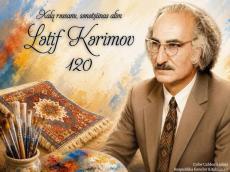
A presentation titled "Latif Karimov: A History Living in Patterns" has been prepared at the Republican Youth Library to mark the 120th anniversary of Latif Karimov, an outstanding representative of Azerbaijani carpet art, educator, art historian, recipient of the USSR State Prize, and People's Artist, AzerNEWS reports.
The presentation was developed within the framework of anniversary events held in accordance with President Ilham Aliyev's Decree of April 30, 2026. Its purpose is to introduce the multifaceted legacy of the distinguished master to younger generations through modern presentation methods.
Created with the assistance of artificial intelligence, the presentation is not merely a collection of biographical facts but also an analytical multimedia resource. It systematically examines Latif Karimov's activities as an artist, scholar, researcher, and guardian of national heritage, while analyzing his historic role in promoting Azerbaijani carpet art on the international stage.
The presentation consists of four sections. The opening section highlights the great master's artistic journey, which began in Shusha. It emphasizes that Karimov regarded carpet weaving not simply as a form of decorative and applied art, but as a cultural chronicle preserving the historical memory of the nation.
The presentation also analyzes his fundamental contributions to the scientific classification of Azerbaijani carpet-weaving schools. Particular attention is given to his research on the characteristics of the Karabakh, Guba-Shirvan, Tabriz, Ganja-Gazakh, and other carpet-weaving schools, through which he established a unified scientific classification system.
Another section explores Latif Karimov's role in the development of narrative carpet art. Special emphasis is placed on the transfer of Nizami Ganjavi’s Khamsa onto carpet designs, described as a significant aesthetic achievement in the history of art.
The section titled "Science Born from Knots: Books and Museums" provides a comprehensive overview of Karimov's scholarly work. It notes that by studying national ornaments through a scientific methodology, he succeeded in introducing Azerbaijani carpet art into the sphere of international academic discourse.
The concluding part of the presentation provides information about the artist's state awards, honorary titles, and rich legacy. It underscores that his contributions to the development of Azerbaijani culture have been highly valued at the state level and that his heritage continues to remain an important component of the nation’s cultural and intellectual identity today.
The presentation "Latif Karimov: A History Living in Patterns" is available on the official website of the Republican Youth Library.
URL: http://www.today.az/news/entertainment/268333.html
 Print version
Connect with us. Get latest news and updates.
See Also
- 11 June 2026 [11:45]
Republican Youth Library honors Latif Karimov on his anniversary - 10 June 2026 [14:25]
National Library launches virtual exhibition on Azerbaijan's Ethnic Minority Communities - 10 June 2026 [12:25]
Said Rustamov Folk Instruments Orchestra to perform jubilee concert - 09 June 2026 [14:04]
Young musicians thrill audience in grand report concert - 09 June 2026 [12:01]
National musician chairs examination commission in Kazakhstan - 08 June 2026 [13:42]
Azerbaijan's Greater Caucasus Biosphere Reserve added to UNESCO World Network - 08 June 2026 [12:43]
Irevan State Drama Theatre re-imagines Akhundzade's classic comedy - 08 June 2026 [11:47]
'Azikh Cave' feature documentary set for upcoming release - 07 June 2026 [10:46]
Azerbaijan, Turkmenistan unite to honor classic poets Shirvani and Azadi in Arkadag - 05 June 2026 [13:47]
Azerbaijan showcases its cultural heritage in Turkmenistan
Most Popular
 Armenia’s elections signal new regional reality shaped by Azerbaijan’s strategic shift
 Azerbaijani Foreign Ministry warns citizens against travel to conflict zones
 Tehran threatens Middle East oil and gas facilities in response to renewed attacks
 Iran said to be prepared for 'long war' with Israel
 Three countries, one course: how the alliance of Baku, Ankara and Tbilisi is strengthening
 Jeyhun Bayramov departs for official visit to Japan
 Baku regulates social media use to strengthen child protection