|
|

TODAY.AZ / Business
Can Azerbaijan's regional airports unlock its tourism potential?
20 July 2026 [14:25] - TODAY.AZ
 By Akbar Novruz
Azerbaijan's tourism bureau has a problem that is easier to describe than to solve. It has spent over $10 billion reconstructing Karabakh, has built three international airports on previously occupied land, and has implemented a grand plan to double its yearly tourist influx from two to five or six million. But the international flight links that would connect tourists to the parts of the country that should most appeal to them, Gabala and its mountains, Lankaran with its subtropical national parks, and northwest Azerbaijan with its historic Silk Road villages, do not, by any realistic measure, exist. This point was made clearly earlier last week when Rashad Aliyev, Deputy Chairman of the Azerbaijan Tourism Bureau, announced that discussions were underway with several airlines to launch regular flights to Gabala, and that one airline is considering turning Gabala airport into a regional hub, like Georgia's Kutaisi.
At present, Azerbaijan has ten international airports apart from the capital city of Baku, which are Ganja, Nakhchivan, Lankaran, Gabala, Zagatala, and five other newer airports located in the liberated lands, namely, Fuzuli, Zangilan, Lachin, Khojaly, and one under development close to Shusha. The figure looks impressive at first glance. But the real scenario is somewhat different. As per Flightradar24 data of July 2026, there is just one international flight route that operates from Gabala International Airport (GBB/UBBQ).
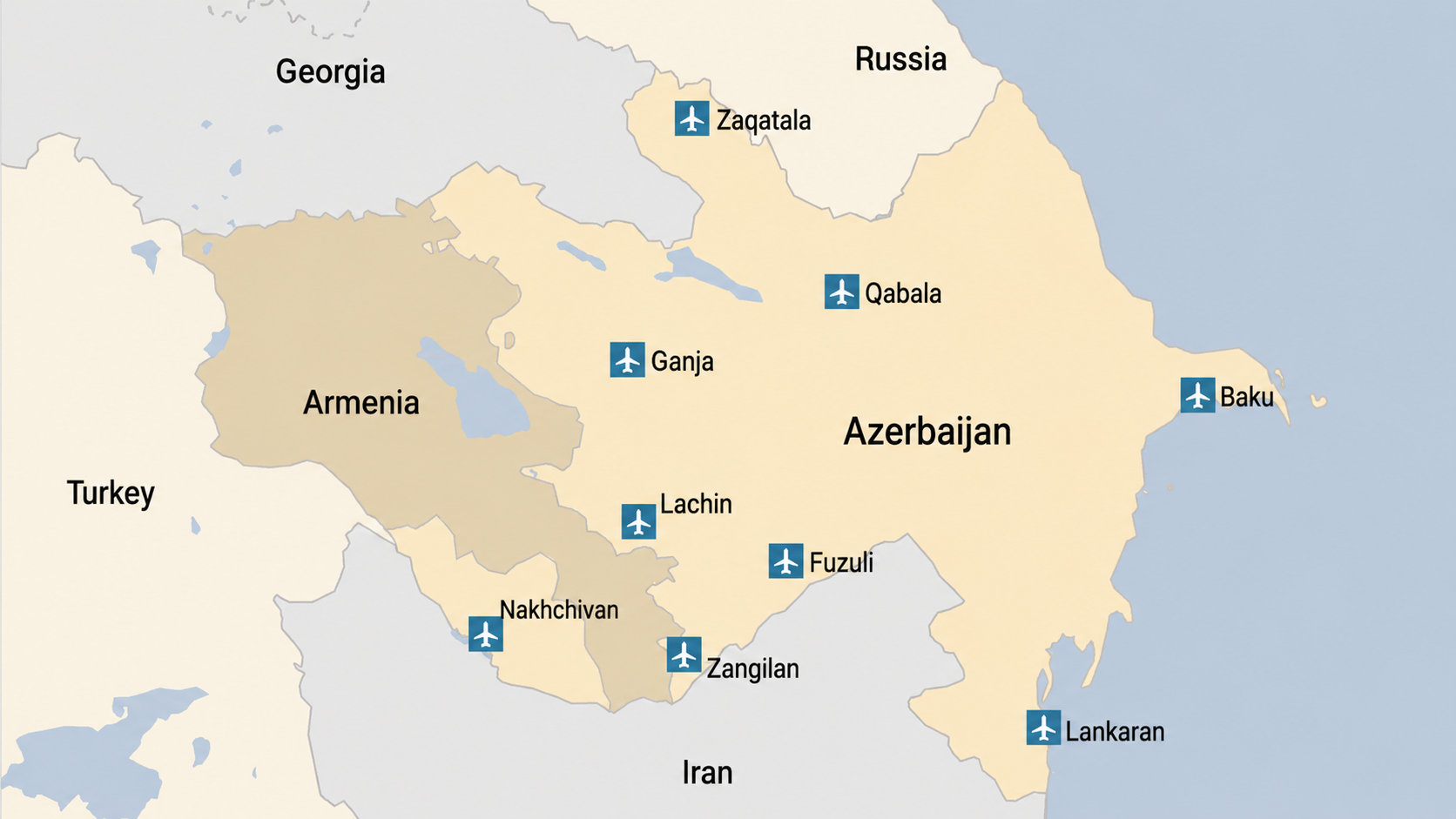
There are absolutely no regular international flights to Zagatala airport. There have been sporadic international flights to Lankaran airport, which were mostly chartered flights during certain seasons, but which could not continue economically. Regular international commercial flights are still few to the Karabakh airports of Fuzuli, Zangilan, and Lachin due to the influx of official visitors and tourists.
Kutaisi comparison
The Kutaisi model, which was presented by ATB's Aliyev as an example of what Gabala should aim to be, is among the most enlightening case studies on regional airport development in the former Soviet bloc. The process of development at Kutaisi International Airport started with the conscious strategy of going only for low-cost airlines, thus presenting a budget-friendly European entry point, while the main airport of Georgia, the Tbilisi's Shota Rustaveli Airport, became too pricey and crowded for regular people. Wizz Air transported almost 1.8 million people through Kutaisi in 2025, making around 6,800 flights with 99.7% capacity utilization and more than 1.5 million check-ins.
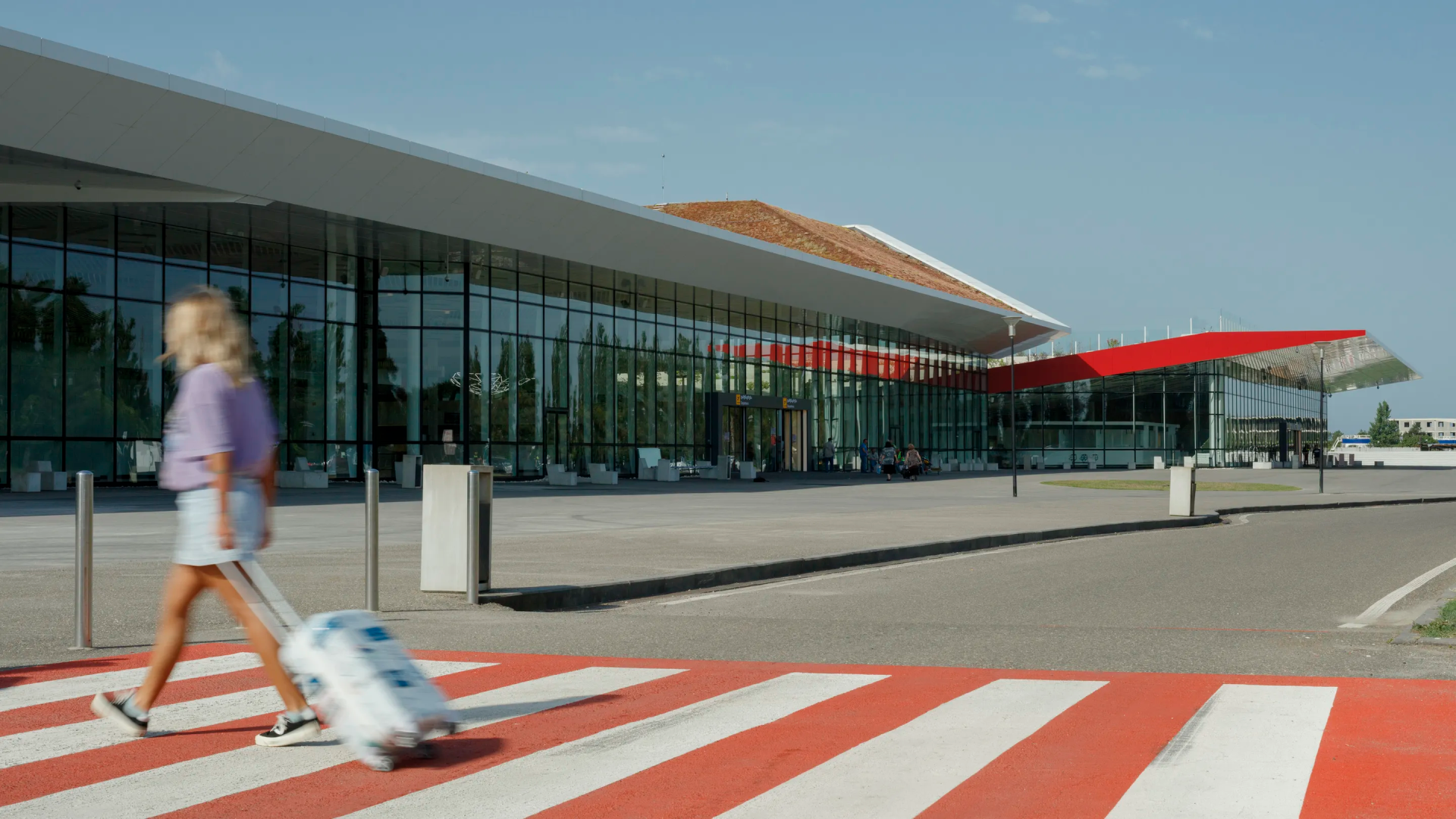
The disparity between how the two airports function now, Kutaisi vs. Gabala, is more than just in numbers, per se. Kutaisi gets 68 Wizz Air flights each week from 23 European and regional cities. Gabala gets three Abu Dhabi flights. For the 2025 figure of 1.8 million passengers at Kutaisi, it took thirteen years since 2012 to achieve from zero. The accomplishment at Kutaisi Airport is a real one, replicable in principle. However, it is neither quick nor easy because of the subsidies to the airport fees, infrastructure investments, and flexible regulations required from the Georgian authorities to make the deal profitable for Wizz Air.
The most important contextual detail in the ATB's announcement is the Wizz Air history. Gabala is not a blank page where low-cost operations have never taken place before. Wizz Air indeed flew out of Gabala – flights to Kyiv, Warsaw, and Budapest were introduced in 2022 and were suspended after some time of operations. This was caused by several reasons – the disruption of Ukrainian flights due to Russia’s invasion, a relatively limited number of people interested in direct connection of Gabala and Eastern European destinations, as well as a lack of hotel and ground transport facilities that would make Gabala operational in isolation and not dependent on the extra travel of tourists from Baku. That Wizz Air operated at Gabala and then left is not a reason to be pessimistic about the model's potential. It is a reason to understand specifically what conditions need to change before the next attempt sticks.
It is clear what has to be changed. The route economics of LCCs flying into regional airports in Azerbaijan are dependent on three factors that could be controlled directly by the government – airport charges and incentive structures for the launch of new routes, development of hospitality and transport facilities that will enable stays of several nights without transit through Baku, and flexible aviation services agreements to allow competition between airlines on these routes. It was not by chance that in 2025 Georgia succeeded in increasing the passenger throughput of Batumi airport by 44% and Tbilisi by 13%. The equivalent growth in Azerbaijan has been achieved only through Baku’s Heydar Aliyev International Airport, with 7.5 million passengers in 2024.
Initiative's potential
ATB's announcement that regional airport activation is a key priority of Azerbaijan's new tourism development programme is significant for one specific reason: it names the right problem. All analyses conducted on the situation with tourism in Azerbaijan, and even the surveys carried out within the sector itself, reveal over-concentration of tourists in Baku as the main structural limitation on the further development of the industry. Tourists who come into Heydar Aliyev International Airport and need to travel by car for three hours to get to Gabala, four hours to Lankaran, or six hours to Zagatala are not merely put through unnecessary trouble – they are actually deprived of the possibility to enjoy the regional tourism due to the time constraint, which is more limiting than the financial one for most of the holiday-makers.
It is thus both crucial and very much at this point, only a fledgling attempt to translate policy into business. Talking with multiple airlines is just a starting point. For an airline to be evaluating the possibility of a hub strategy is a world away from making a commitment to a minimum frequency schedule and network that would make a hub commercially sensible. The Kutaisi precedent, to which ATB's Aliyev referred, provides an example exactly because what made that airport successful was a unique collaboration of an LCC, a willing government to support start-ups of routes, and an appropriate geographical position to allow economics to eventually work. Azerbaijan already has the geography, with Gabala airport being located near the foothills of the Greater Caucasus, located just two hours away from Baku, surrounded by breathtaking natural scenery. But what it needs now is the commitment of the airline, the fees to be charged, and the ground infrastructure to turn the geography into something sensible for a Wizz Air or Ryanair network planner looking to find a spot for a new aircraft base.
The five-to-six million tourist arrival target that President Aliyev set earlier this year cannot be reached through Baku alone. The hotels, the airport, and tourism product offering in Baku are already coping with the current number of visitors very adequately. The growth must happen through the regions, and the growth through the regions cannot happen without the flights. In this respect, the discussion about a Gabala hub is the most strategically significant conversation taking place right now regarding tourism policy in Azerbaijan. It remains to be seen whether this results in a Wizz Air base for Gabala by 2027 or just another round of talks that don't lead to anything, depending on the particulars, such as fee structure, frequency guarantees, transit links, and hotel building program at Gabala and the neighboring Sheki-Zagatala route, that have yet to become public. The ambition is right, but the details are what matter next.
URL: http://www.today.az/news/business/269035.html
 Print version
Connect with us. Get latest news and updates.
See Also
- 20 July 2026 [14:25]
Can Azerbaijan's regional airports unlock its tourism potential? - 20 July 2026 [08:30]
As Red Sea risks grow, Middle Corridor becomes Eurasia's most strategic trade route - 19 July 2026 [17:35]
Baku-Yerevan economic engagement lowers regional geopolitical risks - 19 July 2026 [08:30]
Artificial Intelligence becomes new geopolitical battleground - 18 July 2026 [15:56]
Moody's keeps SOCAR's credit rating unchanged - 18 July 2026 [13:36]
Türkiye advances preparations for Azerbaijan-Bulgaria green electricity corridor - 16 July 2026 [12:29]
Kazakhstan transits 704,000 tons of oil via BTC pipeline in H1 2026 - 16 July 2026 [11:23]
Anglo Asian Mining posts $159 mln in H1 revenue as copper sales surge - 15 July 2026 [10:41]
Baku hosts first meeting under OPEC+ charter of cooperation - 14 July 2026 [12:43]
Azerbaijan and Turkmenistan discuss expanding trade and launching joint business council
Most Popular
 Argentina goalkeeper Emiliano Martínez breaks World Cup final record
 Moderate 5.6 earthquake hits central Peru with no reported damage
 Temperature to reach 38°C in Azerbaijan regions tomorrow
 AEOI slams US attack on Darkhovin nuclear site as international law violation
 Bayern Munich and PSG launch official bids for Djed Spence
 Artificial Intelligence becomes new geopolitical battleground
 Samsung cuts US jobs, offers relocations ahead of HQ move