|
|

TODAY.AZ / Analytics
China’s manufacturing surplus poses new test for global economy
19 August 2026 [08:30] - TODAY.AZ
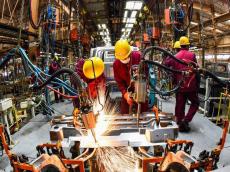
China's industrial machine is producing an ever-growing volume of goods, but the global market's capacity to absorb them is beginning to look increasingly limited. Trade barriers are rising, domestic demand remains weak, and Chinese companies continue to expand capacity while cutting prices. This model could create serious problems not only for China, but also for commodity markets and competing manufacturers around the world.
According to Foreign Affairs, China's trade surplus has reached record levels over the past two decades. In 2025, it totaled nearly $1.2 trillion. China already accounts for about 30% of global manufacturing output, and by 2030 that share could rise to 45%. The OECD has argued that a significant part of this industrial expansion has been supported by state subsidies.
Chinese companies often continue increasing production even as profit margins decline. The automotive industry offers one of the clearest examples. China reportedly has enough capacity to produce around 25 million electric and hybrid vehicles annually, while domestic demand is closer to 12 million. Across all types of vehicles, the country's total annual production capacity may be as high as 55 million units.
The consequences are already visible abroad. The European Union has imposed additional tariffs on Chinese electric vehicles, while German automobile exports to China fell sharply between 2022 and 2025. Chinese manufacturers are no longer competing only in low-cost consumer goods. They are increasingly challenging established companies in cars, machinery, batteries, solar technology, steel and other strategically important industries.
There is a paradox at the heart of China's economic model: the more powerful its industrial sector becomes, the more destabilising it can be when demand fails to keep pace.
If Chinese consumers and businesses cannot purchase everything the country's factories produce, companies must find customers overseas. The real danger is therefore not simply that China has large factories or continues building new ones. It arises when excess production is systematically redirected toward foreign markets that are already struggling to absorb it.
Imagine a Chinese factory capable of producing one million electric vehicles a year, while domestic buyers purchase only 500,000. Simply shutting down half of the production lines is not an attractive option. The investment has already been made, machinery must remain in operation, workers need to be paid, and the company must defend its market share. The remaining 500,000 vehicles are therefore offered abroad. To sell them, the manufacturer cuts prices. Foreign competitors must then respond with discounts of their own, even if their costs are higher. What began as excess capacity inside China becomes downward pressure on prices and profit margins across the global market.
The same mechanism is particularly visible in steel. Weak domestic demand encourages Chinese producers to export more, while surplus capacity pushes down international prices. China's steel exports reportedly reached a record 131 million tonnes in 2025.
For consumers, lower prices may initially appear beneficial. Cheaper cars, solar panels, batteries and manufactured goods can improve living standards and accelerate the energy transition. But persistently depressed prices can also force factories in other countries to close. Once production disappears, so do skilled jobs, suppliers, engineering expertise and the ability to manufacture strategically important goods domestically.
Recent data suggest the imbalance is becoming harder to manage. Bloomberg and Reuters, citing China's National Bureau of Statistics, reported that economic growth slowed across the board in April, while investment weakened again because export growth was no longer enough to offset falling domestic consumption. Industrial output grew by 4.1% in April, the weakest pace in almost three years, down from 5.7% in March. Reuters later reported another slowdown in summer industrial activity as external shocks and weakening demand added new strain.
Beijing rejects the argument that the country suffers from "overcapacity." In a report titled China's Position on the Issue of So-Called Overcapacity, the Ministry of Commerce dismissed Western concerns about a possible "China Shock 2.0" - a new wave of cheap Chinese imports resembling the disruption that hit the global economy in the late 1990s and early 2000s. Chinese officials called those fears false.
The consequences would not stop at manufacturing. China is one of the world’s largest consumers of oil, gas, iron ore, copper and other raw materials. Its industrial expansion has therefore been a major source of global commodity demand. But an economy producing huge volumes of finished goods does not necessarily require permanently rising amounts of raw materials. If Chinese manufacturers begin cutting production because they cannot sell enough goods, demand for commodities could weaken. That would create a difficult situation for commodity-exporting countries. At first, China’s industrial expansion supports demand for its exports. But if Chinese growth becomes increasingly dependent on producing goods that cannot be sold profitably, a later adjustment could reduce demand for raw materials and put downward pressure on commodity prices.
URL: http://www.today.az/news/analytics/269626.html
 Print version
Connect with us. Get latest news and updates.
See Also
- 05 October 2026 [08:30]
Azerbaijan’s post-war strategy is shifting from territory to ideological security - 30 September 2026 [14:37]
Azerbaijan’s Absheron gas project: economics behind $4.2 billion investment - 30 September 2026 [08:30]
Azerbaijan’s digital investment surges as its non-oil economy seeks new growth - 22 September 2026 [23:00]
Polish companies eye opportunities as Azerbaijan builds digital trade route - 22 September 2026 [13:42]
Trump-Xi summit puts AI, trade, rare earths at centre of new US-China contest - 21 September 2026 [14:11]
Azerbaijan’s manat faces global dollar surge with $15 bln buffer - 18 September 2026 [08:30]
Azerbaijan’s cotton growth shifts focus from export volumes to industrial value - 17 September 2026 [13:24]
Azerbaijan's role in South Caucasus's new architecture - 17 September 2026 [08:30]
Germany questions 'associate member' term for Canada - 09 September 2026 [14:56]
EU needs Azerbaijan more than it likes to admit
Most Popular
 Estonia moves troops and long-range weapons closer to Russian border
 Bitcoin price climbs above $86,000 as crypto market advances
 Suspected plague death triggers quarantine measures in Russia's Irkutsk region
 Reality that Azerbaijan has created for itself
 Bolsonaro takes first-round lead over Lula in Brazil election
 Hormuz Strait disruptions could push grain prices up by 80%, ICC warns
 President Ilham Aliyev received newly appointed ambassador of Austria to Azerbaijan