|
|

TODAY.AZ / Analytics
Azerbaijan's new alliance with Kyrgyzstan marks rise of Central Asian Caspian region
01 August 2026 [08:30] - TODAY.AZ
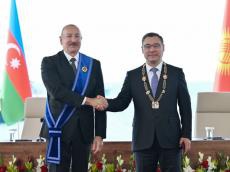
President Ilham Aliyev's two-day state visit to Kyrgyzstan may ultimately be remembered as more than another diplomatic exchange, as the key outcome of the visit was the signing of the Declaration on Allied Cooperation, which elevated relations between Baku and Bishkek to a qualitatively new level. Kyrgyzstan has thus become Azerbaijan's third ally in Central Asia after Kazakhstan and Uzbekistan, and its fifth ally overall.
It is highly symbolic that during the visit, both leaders - Ilham Aliyev and Sadyr Japarov - awarded each other with the highest state awards of their countries, where the President of Kyrgyzstan presented his Azerbaijani counterpart with the Order of Manas of the first degree, the highest state award of the Kyrgyz Republic, and the Azerbaijani President awarded Sadyr Japarov with the Order of Heydar Aliyev, the highest state award of the Republic of Azerbaijan. Such gestures are traditionally used only in relations between the closest partners and reflect the desire to consolidate the long-term character of bilateral cooperation.
Therefore, the transition from a strategic partnership to allied relations demonstrates the exceptionally high degree of political trust between the two countries. This trust is particularly important amid growing conflicts, geopolitical tensions, and divisions across the international system.
However, President Aliyev's visit and the documents signed during it should be viewed in a broader context rather than solely through the prism of bilateral relations.
Commenting on the development for AzerNEWS, Aynur Nogayeva, a professor at Erzincan Binali Yildirim University, noted that the emerging partnership reflects a wider regional transformation.
"It is important to understand that this is not about Azerbaijan joining Central Asia. Rather, we are witnessing the formation of a single Central Asian-Caspian region, in which the Caspian Sea is increasingly becoming an internal space that connects countries rather than a boundary that separates them," the expert said.
Nogayeva stressed that the allied relationship between Bishkek and Baku is a clear manifestation of this trend. According to her, the states of the Turkic world are gradually moving beyond the traditional partnership model toward long-term political consolidation.
She noted that this process is based not only on shared historical origins and cultural ties, but also on converging strategic interests in transport, energy, security, and international affairs.
An expert further emphasised that Azerbaijan should no longer be viewed merely as a bridge between Central Asia and the South Caucasus. Instead, it is becoming one of the main pillars of an integrated Central Asian-Caspian space.
Nogayeva added that this emerging geopolitical area is gradually developing its own political agency and assuming an increasingly prominent role in Eurasian affairs.
Thus, the main result of the state visit was not only the legal formalisation of allied relations, but also the beginning of the formation of a new model of interaction between Azerbaijan and Kyrgyzstan, where the emphasis is gradually shifting towards practical integration, especially the development of transport corridors, mutual investments and joint infrastructure projects. These areas should become the main content of the Azerbaijani-Kyrgyz alliance in the coming years.
URL: http://www.today.az/news/analytics/269197.html
 Print version
Connect with us. Get latest news and updates.
See Also
- 07 October 2026 [08:30]
Baku, Astana tap Caspian to redraw Eurasia’s digital map - 05 October 2026 [08:30]
Azerbaijan’s post-war strategy is shifting from territory to ideological security - 30 September 2026 [14:37]
Azerbaijan’s Absheron gas project: economics behind $4.2 billion investment - 30 September 2026 [08:30]
Azerbaijan’s digital investment surges as its non-oil economy seeks new growth - 22 September 2026 [23:00]
Polish companies eye opportunities as Azerbaijan builds digital trade route - 22 September 2026 [13:42]
Trump-Xi summit puts AI, trade, rare earths at centre of new US-China contest - 21 September 2026 [14:11]
Azerbaijan’s manat faces global dollar surge with $15 bln buffer - 18 September 2026 [08:30]
Azerbaijan’s cotton growth shifts focus from export volumes to industrial value - 17 September 2026 [13:24]
Azerbaijan's role in South Caucasus's new architecture - 17 September 2026 [08:30]
Germany questions 'associate member' term for Canada
Most Popular
 Suspected plague death triggers quarantine measures in Russia's Irkutsk region
 Estonia moves troops and long-range weapons closer to Russian border
 Bitcoin price climbs above $86,000 as crypto market advances
 Reality that Azerbaijan has created for itself
 President Ilham Aliyev received newly appointed ambassador of Austria to Azerbaijan
 Hormuz Strait disruptions could push grain prices up by 80%, ICC warns
 Bolsonaro takes first-round lead over Lula in Brazil election