|
|

TODAY.AZ / Analytics
Baku expands its European energy footprint through landmark Serbia partnership
17 February 2026 [15:28] - TODAY.AZ
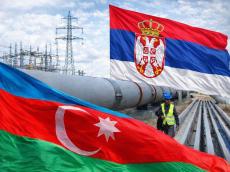
In geopolitics, when corporate interests align with genuine partnership, the outcome is often durable and mutually beneficial. The relationship between Azerbaijan and Serbia is a strong example of this dynamic, where strategic cooperation is producing long-lasting results for both sides.
Serbia and Azerbaijan have formalised a landmark energy cooperation agreement by signing an agreement to construct a gas-fired power plant near Niš. Developed jointly by Serbia’s state-owned Elektroprivreda Srbije (EPS), Srbijagas, and Azerbaijan’s SOCAR, the plant will have a capacity of 350 MW of electricity and 150 MW of thermal energy. This new facility will provide baseload power to meet rising domestic consumption and support Serbia’s expanding industrial and digital infrastructure.
This project reflects a strategic shift for both countries, positioning Azerbaijan as a supplier of fossil fuels as well as an alternative energy provider for Europe. As President Ilham Aliyev stated:
“Now Serbia will also convert the gas to be exported into electricity, thereby acquiring clean electricity. This will create opportunities for both the Serbian market and for future exports. Today, Azerbaijan's export potential in the energy sector is 2 gigawatts. This figure will only increase because we are now engaged in the construction of many renewable energy plants and are ready to cooperate with Serbia in this area.”
The initiative aligns with Azerbaijan’s broader energy strategy, which aims to add an additional 8 gigawatts of capacity by 2032, a significant portion of which is earmarked for export to Europe.
President Aleksandar Vu?i? highlighted the importance of infrastructure readiness and long-term planning, highlighting the expansion of sources as a tremendous opportunity in a turbulent economic era.
“The era of electricity is beginning, and we need many sources of electricity. We need to produce more electricity. Azerbaijan will have electricity measuring gigawatts."
As President Vu?i? mentioned, the construction will take more than two years. He expressed confidence that the two countries together will open a gas-fired power plant by 2029. The plant will have a 50/50 ownership model between Serbia and Azerbaijan, a structure that balances investment risks and returns.
In a comment to AzerNEWS, energy expert Ilham Shabanov first underscored the lower risks for Azerbaijan, as it owns half the company's shares.
“If we consider that in Turkiye we bought the thermal power plant of the GAMA Holding on December 23, we bought 100 per cent of the 870 MW plant, but in Serbia the risks will be shared 50 per cent.”
This arrangement ensures that both countries share operational and financial responsibilities, while giving Azerbaijan a role in controlling standards and efficiency, potentially leveraging SOCAR’s experience in modern power generation.
The expert also spoke about the effectiveness of the project, based on international experiences and precedents. Shabanov emphasised that the project represents standard gas-fired electricity generation rather than a “transition” from gas to electricity:
“Countries are different. There is no such concept as the successful application of this…It depends on how you operate it, provide services, and maintain it according to regulations. For example, in Azerbaijan, modernisation efforts have reduced conventional fuel consumption from over 400 grams per kWh to 220 grams at the 8 November thermal power plant in 2025. Meanwhile, in countries like Italy, technical losses and efficiency vary widely, showing that proper operation is as important as technology itself.”
The lesson is clear: the plant’s efficiency will depend on modern equipment, strict operational standards, proper maintenance, and effective fuel management.
Shabanov touched on the main point and emphasised that the gas-fired plant has the potential to diversify Serbia’s energy supply, which has historically relied on Russian imports. He noted, however, that due to its 500 MW capacity, it is unlikely the plant will immediately export electricity outside Serbia. Nonetheless, it strengthens domestic energy security and could serve as a stepping stone for larger regional cooperation.
President Aliyev’s comments frame the project within a broader European energy strategy:
“To achieve this [exporting additional capacity], we need new and larger transmission capacities because our main export destination is Europe.”
By coupling gas exports with electricity generation, Azerbaijan can expand its role in Europe’s energy market while promoting cleaner electricity, supporting both energy security and environmental goals. But of course, there are some main challenges, which are mainly related to the infrastructure and technology of this project. Actually, President Vu?i? also pointed out the necessity of strategic planning, site selection, and complementary infrastructure.
“Three sites have been selected around the city of Niš…The European Union also recognizes this. In short, the construction is expected to take place in Tripale, Krusti, or Niška Banja. However, I think Krusti is the most suitable place. Small modular reactors will be installed. There will be data centers and other issues will be resolved…The pace of the work should be accelerated, and we are grateful to our Azerbaijani friends for their support.”
Key challenges include transmission and grid capacity, as effective integration of the plant will require expansion of infrastructure, particularly if Azerbaijan’s long-term European export goals are to be met. Operational efficiency is another concern; as Shabanov noted, optimal performance depends on careful maintenance and adherence to international standards.
According to the expert, timeline sensitivity is also critical: if the Commercial Agreement is signed in 2026, the plant is likely to begin operations by 2029, leaving the region potentially exposed to energy volatility in the meantime.
Finally, environmental considerations remain important. While gas is cleaner than coal, it is still a fossil fuel, and compliance with EU environmental standards will be essential if Serbia aims to export electricity.
The power plant represents a practical, phased approach to energy modernisation. For Serbia, it provides stable electricity to support economic growth, industrial expansion, and digital infrastructure development. For Azerbaijan, it is both a commercial and strategic foothold in Europe, complementing its growing energy portfolio.
Energy expert Shabanov concluded that this model demonstrates the importance of risk-sharing, operational rigour, and strategic foresight:
“In a country in Europe that has been dependent on Russian energy carriers for many years, it can be seen as Azerbaijan's contribution to diversifying its energy imports and ensuring its own stable energy supply.”
As a reliable partner and a country promising stability, Azerbaijan's energy potential is expanding beyond its borders. The partnership between Azerbaijan and Serbia is emblematic of the evolving energy landscape - one that integrates traditional fuels, regional cooperation, and long-term infrastructure planning to strengthen both national and European energy security.
URL: http://www.today.az/news/analytics/265714.html
 Print version
Connect with us. Get latest news and updates.
See Also
- 30 September 2026 [14:37]
Azerbaijan’s Absheron gas project: economics behind $4.2 billion investment - 30 September 2026 [08:30]
Azerbaijan’s digital investment surges as its non-oil economy seeks new growth - 22 September 2026 [23:00]
Polish companies eye opportunities as Azerbaijan builds digital trade route - 22 September 2026 [13:42]
Trump-Xi summit puts AI, trade, rare earths at centre of new US-China contest - 21 September 2026 [14:11]
Azerbaijan’s manat faces global dollar surge with $15 bln buffer - 18 September 2026 [08:30]
Azerbaijan’s cotton growth shifts focus from export volumes to industrial value - 17 September 2026 [13:24]
Azerbaijan's role in South Caucasus's new architecture - 17 September 2026 [08:30]
Germany questions 'associate member' term for Canada - 09 September 2026 [14:56]
EU needs Azerbaijan more than it likes to admit - 08 September 2026 [08:30]
Azerbaijan’s wind boom opens new front in Europe’s energy market
Most Popular
 Czech CSG plans to manufacture self-propelled howitzers in Azerbaijan from 2027
 ASELSAN strengthens partnership with Azerbaijan at ADEX 2026
 Pentagon announces new autonomous warfare command to accelerate drone development
 Baku welcomes World Aquatics Swimming World Cup
 Three earthquakes strike Russia
 Subtleties of international law and how they are understood in Armenia
 Rhenus Group plans 14 terminals along Middle Corridor