Today.Az » Politics » The world is returning to overland routes, with Azerbaijan at center
23 June 2026 [14:14] - Today.Az
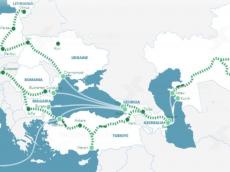
The analytical and consulting platform Elevate Crossroads,
specializing in the South Caucasus and the Black Sea region, recently presented
recommendations with a specific roadmap for a three-fold increase in cargo
transportation along the Middle Corridor (Trans-Caspian Transport Route).
It is noteworthy that ten recommendations affected
Kazakhstan, Georgia, Turkey and even Europe. Azerbaijan is not mentioned. But
not because analysts do not attach importance to our country, but because the
Azerbaijani side has provided all the necessary conditions for international
transit through its territory. Azerbaijan is the strongest link in the
logistics chain running from East to West.
Azerbaijan's role as a key participant in the Middle
Corridor is discussed at almost all international meetings where logistics is
discussed in today's difficult situation on the continent. In terms of
transport connectivity, it would not be an exaggeration to state that all roads
lead through Azerbaijan. This is not a figurative expression, but a statement
of reality. And this contributes to the constant growth of interest in the
country and its opportunities.
The geopolitical upheavals that Eurasia is experiencing
today are forcing Europe to pay more and more attention to the South Caucasus.
Recently, the possibilities of integrating logistics routes in Eurasia have
become more frequently discussed, which is important for Europe in conditions
when the rapid circulation of the traditional northern route continues to move
away.
Recently, an international round table was held in Kiev on
the topic of interaction between the Intermarium project and Asia.
According to experts, the interaction between the Middle
Corridor (Trans-Caspian International Transport Route) and the Intermarium project
(Intermarium, Three Seas Initiative) is one of the most promising areas for the
formation of a new Eurasian logistics architecture. Although Intermarium is
more of a geopolitical project based on concern for the physical security of
the countries of Eastern and Central Europe, nowadays it has transformed into
an economic and infrastructural partnership of the EU countries. As such, the
interests of this project and the Middle Corridor overlap.
As you know, the Middle Corridor connects China with the
European Union through Kazakhstan, Azerbaijan, Georgia and Turkey. The
Intermarium project unites the countries between the Baltic, Black and Adriatic
Seas in order to develop transport, energy and digital infrastructure along the
North-South axis. In this case, this intra-European route should be
distinguished from the North-South corridor running from the borders of
Northern Europe to the Persian Gulf.
Although Intermarium is only a European project, its
integration with the Middle Corridor has great prospects. These two routes
complement each other. Let's imagine that the cargo is shipped from China,
passes through Kazakhstan, Azerbaijan, Georgia, and gets through the Black Sea
ports of the latter, say, to Romania. Romania, being a member of the Intermarium
project, transits goods further along the chain. Poland, Hungary or Slovakia
can become the same points of intersection of routes.
For Azerbaijan, the combination of projects opens up
additional opportunities. Our country acts as the main hub of the Middle
Corridor due to the availability of all necessary infrastructure, including a
powerful commercial seaport in Alat, the modern Baku-Tbilisi-Kars railway (BTK)
and the largest merchant fleet on the Caspian Sea. Moreover, Azerbaijan builds
the vessels itself, which raises its price even higher.
The connection of the Middle Corridor and Intermarium will
allow the country to go beyond the regional transport player and become part of
the pan-European logistics network. Azerbaijan has always advocated and
continues to advocate for the expansion of connectivity in Eurasia and the
creation of alternative routes to traditional routes. This allows trading not
to depend on any players and not to stop in case of geopolitical problems. The
events of recent years make it possible to once again draw the attention of
Azerbaijan's European partners to how far-sighted the decisions made by Baku
and underestimated by Europe were. The same BTK road.
The possibilities of integration with the Middle Corridor
for access to Asia have become critically relevant for the Intermarium area
after the outbreak of the war in Ukraine and the breakdown of traditional
Eurasian logistics. And the destabilization in the Middle East and the war
between the United States and Iran have led to serious risks for international
shipping routes. And international trade began to move to the "land"
again. And what is important is that in fact, there is nothing new in the
interest of Europeans in our region. The situation is simply returning to its
historical course.
As he said in an interview with Day.According to Azerbaijani
political scientist and historian Rizvan Huseynov, Azerbaijan and the South
Caucasus as a whole have served as natural hubs for transit routes in Eurasia
throughout history. These routes went from China through Turkestan to Europe
and from the north, from modern Russia towards the Persian Gulf. Today, these
routes are called North-South and West-East.
"As in our days, Azerbaijan, or even more precisely,
Shirvan, has historically been the natural intersection of all these paths.
This was also the case during the Silk Road, when silk was a strategic
commodity, playing the same role as oil and gas today. The demand for silk was
growing, Azerbaijan was a transit hub for silk caravans moving west from China
and Turkestan (present-day Central Asia), and also produced silk itself. That
is, he traded and provided transit. It was an important source of income and, at
the same time, the cause of endless wars and conflicts that were fought for and
around Azerbaijan.
The situation changed when the great maritime trade routes
became the main logistics system in the world. After the great geographical
discoveries, after the creation by Europeans of stable maritime trade routes
from Asia and Africa to Europe, the importance of land routes began to weaken.
The silk factor gradually faded away.
There were big wars in the region. In the end, tsarist
Russia took control of the Caucasus, cut off its transit opportunities and
turned it into a dead end. Azerbaijan has lost the opportunity for a stable
wide access to the territories of modern Iran, Turkiye, and Turkestan.
However, today we are witnessing how the natural transit role
of the South Caucasus and, in particular, Azerbaijan is being restored. Those
countries that have historically carried out transit through our territory are
also being connected to the region-wide road network, and network transport
relations are being restored in the space from China to Europe, including
Central Asia and the South Caucasus. Eastern Europe is being connected to the
network as part of the Intermarium project, also called Intermarium and
Trimarium. This project connects the Baltic, Adriatic and Black Seas and 12
countries.
We can confidently say that historical onshore transit
capacities are being restored today. The main reason for returning to the
"land" is that the safety and stability of maritime transport routes
is becoming more and more problematic. We see the conflicts taking place in the
Persian Gulf, the Strait of Hormuz, and potential risks to safe navigation in
the Bab el-Mandeb Strait, the Strait of Malaka, and the Red Sea. The threat to
the security and stability of maritime supplies leads to the strengthening of
overland transit routes. And this gives Azerbaijan and other countries in the
region the opportunity to regain their role on the largest land transit routes
in Eurasia. Which is what is being done today."
|
