
Otto von Bismarck is credited with a phrase that is still very relevant today: “The main thing is to capture a foreign city. And then historians will explain why these are our lands from time immemorial.” Perhaps the German chancellor had nothing to do with these words, but that doesn’t change the essence. This is precisely the philosophy that invaders have been guided by throughout history. Empires and powerful states didn’t have much need for such justifications; they simply took what wasn’t theirs and declared a change of ownership. Small?time aggressors, thieves, and those who received other people’s lands as payment for services had to put in serious effort to hold on to what they had acquired unjustly.
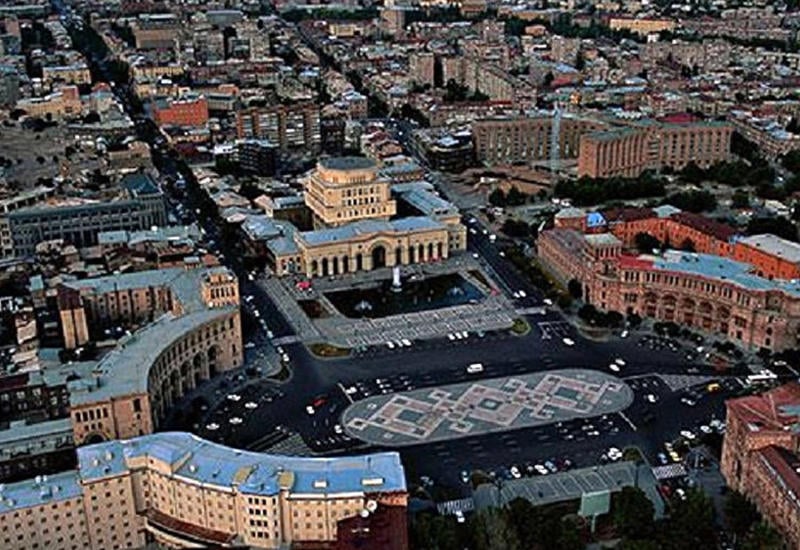
The latter is precisely about our neighbors. Recently, Yerevan celebrated its city day. And we wouldn’t have remembered this if Armenian media hadn’t decided to quote the head of the revanchist opposition, Samvel Karapetyan, who, in his own style, congratulated the residents of Yerevan on their “2,808th anniversary.” In addition to the usual flattery, the Russian billionaire stated that Yerevan, supposedly, “has never lost its Armenian character and identity.” And he assured that “our capital, which has evolved from Erebuni to Yerevan, will never become Erivan.”
The latter was addressed to Azerbaijan. It wasn’t worth it. But the foolishness has already been done, so a few words should be said. Not in the context of making claims to a neighbor’s territory, but merely for the purpose of educating the Armenian audience, which continues to believe in fairy tales.
Let’s not argue — Yerevan will not become Erivan. Because that’s also a contrived name, and the city’s historical, proper name is Irevan. Before the resettlement of Armenians to the South Caucasus and the transfer of Irevan to Armenia as its capital a hundred years ago, the medieval Azerbaijani city had no “Armenian character and identity.” However, in the 1950s, as part of a new version of the region’s history, it was shamelessly dated back further and turned out to be older than the Italian capital.
I recall the joyful excitement in the Armenian media on the eve of the “2,800th anniversary” of Yerevan, which was to be celebrated in 2018. Long before that date, celebrations and concerts were being prepared, and songs and dances were being rehearsed. The imagined anniversary was supposed to have an international scale. But six months before the event, a coup occurred, and the atmosphere changed. As a result, the “anniversary” celebration passed without much pomp, boringly and even drearily. The expenses planned for the festivities were cut back, and the numerous foreign guests, scientific conferences, and so on that had been planned remained only in dreams. The ambitious “Old Yerevan” project, which was supposed to create a historical center in a city “older than Rome,” got stuck halfway. The real historical center, which was a little over 500 years old, was razed to the ground and covered with asphalt, so the Armenians had nothing to show and had to improvise, following the saying “necessity is the mother of invention.”
But the most unpleasant surprise for the public, which was excited by its own “antiquity,” was the absence at the celebrations of the then?acting Prime Minister Nikol Pashinyan, who suddenly decided to fly to Lebanon.
By the way, in 2026, Nikol Pashinyan also offered a unique way to congratulate his fellow citizens on City Day. After philosophically pondering the past and present history on social media, he called for “understanding history not as what has already happened, but as what should happen.” He believes that this perception “makes us full?fledged authors of history, since it is being created now and must be created tomorrow.” And what happened in the past is merely historical experience, showing what should not be done in order to avoid running into even greater troubles.
The Prime Minister of Armenia quite reasonably pointed out that today Armenians are for the first time creating their own history, rather than reproducing it. And this is correctly noted — Armenians have indeed always tried to build the present based on a contrived past, and that is why we got what we got. Pashinyan suggested that his fellow countrymen start building a real Armenia. And, we would add, there should be no place for the idea that “Yerevan is older than Rome.”
In the 1950s, the party and the government decided to make the Armenians the oldest people in the Caucasus. As part of this campaign, the “ancient capital of the Armenians” was discovered, some inscriptions from the Urartian period were promptly found — and the whole thing took off. As historian Rizvan Huseynov previously commented, no sources contained any photographs or critical scientific analysis of this inscription, which often appeared in scientific materials. And although it was spoken of as a forgery, it continues to this day to be mentioned and promoted by the Armenian side as evidence of the non?existent “Armenian” history of the Azerbaijani city of Irevan.
The so?called Erebuni, presented as the ancestor of modern Yerevan, is in fact entirely a modern fabrication, noted an Azerbaijani historian. “At the site where excavations began, there were only the foundation stones of a Urartian fortress.” Later, they were “expanded,” and in their place, an entire fortress was built, and in 1968, the luminaries of Soviet science were invited to the supposedly “2750th anniversary” of Erebuni. Among the guests were Boris Piotrovsky, Academician Mints, and other luminaries. And they all asked one question with irony and indignation: what is this, and where did it come from? To which the Armenian side innocently replied that it was, supposedly, a temporary set?up, so that tourists and the local population could see with their own eyes what ancient Urartian structures looked like,” Guseynov said.
Around such a fake “historical Yerevan,” they continue to dance the rounds. In fact, the entire history written over the past 60-70 years for Armenia is a set?up. But this is of no fundamental importance for the future if we focus on reality rather than on fairy tales, legends, and toasts.
The recent CIS summit held in Turkmenistan has become a source of new accusations against the Armenian government, which is allegedly trying to rewrite history. Not only did Pashinyan speak about the Alma?Ata Declaration in Turkmenbashi, but he is also erasing the “deeds” of his predecessors.
If the current authorities have indeed taken it upon themselves to clean out the Augean stables of Armenian history, this indicates their serious attitude towards the future of the region. Of course, it is impossible to forget what happened and what caused so much suffering, but the very fact that this past is acknowledged as a disgrace deserves approval. According to diaspora media, the Ministry of Foreign Affairs is “secretly purging” its official resources of everything related to “miatsum.” Statements about the “self?determination of Artsakh” and territorial claims against Azerbaijan have been removed from the section on foreign policy. At one time, the agency identified the “right to self?determination” of the Armenians of Karabakh, the transfer of Azerbaijani regions to Armenia for land connectivity with the separatist entity, and international security guarantees for the separatists as its main foreign policy goals. Now these goals are being removed. And these are completely natural steps on Yerevan’s part. The policy has changed; the aggressive, toxic, and hate?filled non?state is beginning to transform into a normal member of the international community and, accordingly, is trying to shed its previous narratives. These narratives will drag it back to the bottom.
Do our neighbors want to go back there? That’s not a question for us.
In short, Karapetyan is right — Yerevan will never be Erivan again. But people like him should keep in mind that they themselves are doing everything to ensure that today’s Armenian capital regains its historical name and once again becomes Irevan.